
Soil Compaction: Definition, Process and Checklist
Date: August 12, 2026
Typically, when you mention soil compaction, your contractor will understand it as topsoil or virgin ground compaction—specifically, formation level compaction. Conversely, when discussing aggregate compaction, they will think of imported aggregates or 'fill' compaction, which includes materials like sands, gravels, and crushed rock to be installed on the site.
In either scenario, soil and aggregate compaction represents a critical phase across almost all construction locations, facilitating on-site operations by establishing a robust and capable foundation necessary for secure building processes. Fundamentally, this process increases the density of the material while minimising the presence of air cavities. When properly engineered, compaction not only boosts load-carrying capabilities but also mitigates potential shifting or uneven sinking, thereby reinforcing the enduring durability of a build.
Nonetheless, reaching the necessary density thresholds poses a significant test due to fluctuating soil and aggregate compositions, unfavourable hydration levels (excessive dryness or oversaturation) frequently exacerbated by meteorological conditions, diverse field settings, and deficient compaction methodologies.
Adverse weather conditions often cause changes in moisture content, which can result in inadequate compaction. Furthermore, unexpected ground conditions or fill compositions can compromise structural performance, leading to construction delays and increased maintenance requirements, all of which can become highly costly. To determine the most efficient compaction method for specific surfaces or aggregates, an assessment is typically conducted by earthworks professionals or contractors.
This evaluation involves site compaction trials using appropriate machinery for the given soil or aggregate types, alongside laboratory testing to determine the moisture content versus dry density envelope. The data obtained from laboratory testing subsequently informs the target values for on-site compaction activities and quality assurance controls.
In this guide, we’ll explore what soil and aggregate compaction is, its importance, and how to achieve optimal results. We’ll also cover how compaction is measured, the key factors that influence performance, a compaction checklist, and how mechanical stabilisation solutions can help overcome challenging conditions to deliver stronger, more efficient construction outcomes.
Looking for something in particular? Use the links below to navigate straight to it:
What is soil and aggregate compaction?
Why is soil and aggregate compaction important?
The compaction process
How is compaction measured?
Soil and aggregate compaction checklist
Factors affecting compaction
ETEX Factory Extension achieves a 60% reduction in construction costs with Tensar
How Tensar can support ground improvement proj
Save on time and costs on your next soil compaction project
Try our free geotechnical design software, Tensar+, or contact us to see how we can help you.
Get in touch
What is compaction in earthworks?
Compaction is the process of densely packing particles tightly together, often in the presence of moisture, to remove air pockets (reducing air voids). This results in increased dry density and improves the engineering properties of the compacted layers. This is usually achieved by applying mechanical force such as rolling, tamping, or vibrating the material.
Compaction changes the physical structure of the layer, making it stronger and more resistant to deformation under heavy loads. Note that the compaction of many aggregates will reduce permeability. If this is an undesired outcome, an additional drainage system design should be considered. It is critical to apply appropriate techniques to achieve target density values; using incorrect methods on certain aggregates, especially during wet weather, can lead to project delays and structural issues.
Why is compaction important?
Compaction is a fundamental component of earthworks and infrastructure projects. Creating a competent surface for construction—for both temporary and permanent works—is crucial to site success. Buildings, roads, railways, embankments, and other infrastructure rely on adequate compaction. By increasing density and reducing air voids, compaction improves ground engineering properties, minimising surface deformation, increasing structural stability, and extending the service life of assets while reducing maintenance requirements.
Improves load-bearing capacity
One of the primary benefits of compaction is the improvement of the load-bearing capacity of the compacted layers. As particles are pressed closer together, the material becomes denser and the internal friction angle increases, causing shear strength to rise. This allows the ground to support heavier loads without excessive deformation or instability. Ensuring design engineering parameters are met requires adequate compaction to provide a stable base and control the risk of structural failure.
In many cases, geogrids can be incorporated within the compacted aggregate layers. This further enhances the engineering properties and extends the lifespan of projects such as unpaved roads, rail capping, and ballast layers.
At the HS2 Stoneleigh Park project in Warwickshire, variable subgrade conditions created challenges for supporting high pilling rig track pressures during piling operations. Tensar used its T-Value method with InterAx® geogrid to design a mechanically stabilised working platform that improved the bearing capacity and stiffness of the granular layer, allowing construction to proceed safely with a reduced platform thickness. The solution delivered estimated savings of £250,000 in construction costs, reduced construction time by 75%, and lowered embodied carbon emissions by 75%.

At HS2 Stoneleigh Park, Tensar InterAx®geogrid helped deliver a mechanically stabilised working platform with improved load-bearing capacity and enhanced ground performance.
Reduces settlement
Poorly compacted material contains air voids that can compress over time as loads are applied, leading to uneven deformation at the surface. Effective compaction reduces this risk by creating a competent surface before subsequent works begin. Minimising deformation within formation levels and aggregate layers helps prevent cracking in roads, foundations, and pavements, protecting structural integrity throughout the project's life.
Improves durability and performance
Well-compacted material provides a uniform and stable foundation that improves long-term durability. It reduces the likelihood of surface movement, rutting, erosion, and water infiltration. By creating a stronger foundation, compaction helps infrastructure withstand repeated loading and varying environmental conditions, extending its operational lifespan.
In the context of unpaved roads, Tensar geogrids can be introduced during construction to create a mechanically stabilised layer. Installed within the compacted granular fill, the geogrid enhances properties through interlock, improving the load spread angle and reducing pressure on the subgrade. This can extend the service life of unpaved roads by a factor of three or more while reducing maintenance costs by up to 50%.
The soil compaction process
Achieving effective soil compaction requires more than simply passing a roller over the ground. Following a structured approach ensures the finished ground provides the strength, stability, and long-term performance needed for a construction project.
Soil assessment
Before compaction begins on a formation surface or with virgin soils, the material should be assessed to determine its type, condition, and suitability. Different materials respond differently: granular soils like sands and gravels compact most effectively with vibration, while cohesive soils like clays generally require kneading or impact forces. Site investigations, laboratory testing, and visual inspections help determine the most appropriate strategy.
Compaction of aggregates is generally more straightforward and typically follows the Specification for Highway Works for the given material type.
Moisture conditioning
Moisture content significantly influences performance. Material that is too dry may not bind effectively, while overly wet material can become unstable. While subgrades rarely receive moisture treatment, ex-situ aggregates or clays may require the addition of water or time to dry until the optimum moisture content is reached, enabling maximum dry density.
Selecting the compaction method
The chosen compaction equipment depends on the material type, project scale, and site conditions. Vibratory rollers are standard for granular materials, while padfoot (sheepsfoot) rollers are more effective for cohesive soils. Plate compactors and rammers are used in confined areas like trenches. The Specification for Highway Works provides detailed instructions on equipment and the required number of passes.
Layer placement and compaction of an aggregate
Aggregate or fill is typically placed in thin, uniform layers of 100mm to 300mm, known as 'lifts'. Compacting each lift individually ensures density is achieved throughout the full depth. Lift thickness and the number of passes depend on the material type, equipment, and project specifications.
Using geogrids alongside aggregate compaction
Using geogrids with aggregate creates a high-performance, mechanically stabilised layer. Tensar geogrids stabilise the granular fill through aggregate interlock, enhancing confinement. This creates a stiffer, more durable layer that distributes loads effectively and reduces settlement and rutting by restricting lateral particle movement.
Testing and verification
Testing confirms that specifications have been met. Field density tests, moisture measurements, and load-bearing capacity assessments verify that the material was installed correctly. Testing is an essential quality control measure that reduces the risk of future issues like surface deformation or structural cracking.
Looking to incorporate geogrids into your next project?
Get in touch with our team for a free design consultation.

How is soil compaction measured?
Measuring soil compaction ensures that the ground has reached the required density before construction progresses. Read on to discover the most common soil compaction methods used to measure compaction quality, helping to reduce the risk of deformations and improve structural performance– all while staying compliant with project specifications.
Soil compaction Maximum Dry Density (MDD)
Compaction is commonly measured as a percentage of the Maximum Dry Density (MDD) determined through laboratory testing, such as the Proctor Test. Specifications typically require reaching 95% or 98% MDD depending on project requirements.
Achieving the specified percentage suggests the material will provide the required load-bearing capacity. Higher percentages are specified for roads, pavements, and structural foundations.
Compaction curve of soil
The compaction curve of an aggregate sample shows the relationship between moisture content (MC) and dry density. As moisture increases, dry density also increases until the optimum moisture content (OMC) is reached; additional water will then cause the dry density to decrease.
Designers use the compaction curve to determine ideal moisture conditions before work begins. For overly wet cohesive soils, lime is sometimes used to accelerate the drying process and enhance compaction.
Field testing methods
Once compaction is complete, field testing verifies results. Common techniques include nuclear density gauge testing, dynamic cone penetrometer (DCP) testing, lightweight deflectometer (LWD), and the Clegg hammer.
Where performance under load must be assessed, plate load testing evaluates the stiffness of the compacted layers by measuring settlement in response to a controlled load.
Soil compaction checklist
Now that we've covered the principles of compaction in earthworks, use the checklist below to ensure the process has been assessed adequately and tested to meet project specifications.
Assess the soil and/ or aggregate type.
Confirm optimum moisture content of the compacted aggregate.
Select the correct compaction equipment for the type of aggregate (based on Highway Works Specification) .
Place fill in the specified lift thicknesses.
Compact each lift with the specified number of passes.
Perform testing at the required frequency.
Inspect the finished surface for soft spots or instability, including proof rolling.
Address any encountered soft spots with remediation (e.g., dig and replace).
Factors affecting soil compaction
Achieving required compaction levels depends on more than just the right equipment. Several factors influence density and ground performance. Read on to discover common challenges and the solutions that help deliver long-lasting results.
Soil type
Different materials respond differently to compaction. Granular, non-cohesive soils like sands and gravels typically compact well under vibration, while cohesive soils like clays require kneading or impact forces. Proper assessment and method selection are crucial to reaching specified levels.
On the CloudHQ Data Centre project, Tensar faced the challenge of creating a cost-effective working platform using recycled site-won materials across the 44,000m² development area. Understanding the characteristics of the available aggregate and recycled materials was key to selecting the right engineered solution. Using the "T-Value" approach, Tensar assessed the material properties and determined the required working platform thickness, incorporating Tensar InterAx® geogrid within a stabilised construction using Class 6N material (Highway Works Specification Series 600). This solution delivered an estimated £350,000 (48%) reduction in construction costs and reduced construction time by 70 days (58%).
Tensar used the "T-Value" approach incorporating InterAx geogrid at the CloudHQ Data Centre, resulting in a 48% cut in construction costs and a 58% reduction in construction time.
Moisture content
Moisture content has a major impact on effectiveness. If the material is too dry, it won’t compact properly; if too wet, it requires drying. Compacting close to the optimum moisture content allows the target dry density to be achieved.
Lift thickness
Compacting lifts that are too thick can prevent the lower portion of the layer from reaching the required density. Conversely, unnecessarily thin lifts can increase construction time and costs.
Site conditions
Factors such as weak subgrades, high groundwater, confined areas, and prolonged wet weather can make it difficult to achieve specified density using conventional methods.
At the Eastleigh Railway Depot project, weaker-than-expected subgrade conditions created challenges for construction access and the support required for permanent works. The ground investigation identified a subgrade CBR value of 0.8%, significantly lower than the expected minimum of 3.4%, meaning conventional construction methods would have required additional ground improvement.
Lomeshaye Industrial Estate: Overcoming Subgrade Failure with MSL Technology
During the initial phase of the Lomeshaye Industrial Estate project in Nelson, UK, contractors encountered subgrade conditions significantly weaker and wetter than pre-construction testing had indicated. Attempts at chemical stabilisation failed, liquefying the existing soils and causing a digger to sink into the formation surface. This brought site preparation to a halt and threatened the project schedule.
To resolve the issue and safely resume operations, Tensar designed a Mechanically Stabilised Layer (MSL) incorporating Tensar InterAx geogrid. Installed directly over the low-strength soils, the MSL provided an immediately stable working platform. The solution successfully accommodated heavy plant loads while achieving the required bearing capacity for the subsequent concrete slab construction. By implementing this approach, the project team avoided further delays, resulting in an estimated 42% reduction in construction time, a 20% saving in material costs, and a 35% reduction in embodied carbon.
ETEX Factory Extension achieves a 60% reduction in construction costs with Tensar
At the ETEX Factory Extension project in Bristol, poor ground conditions and tidal deposits with a high water table posed significant challenges. The project required a stable working platform while minimising imported material. Tensar designed a solution using its T-Value approach and stabilisation geogrids, creating a mechanically stabilised layer that improved load distribution. This allowed site-won recycled materials to be reused while still achieving the required bearing capacity.
Overall, the project achieved a 40% reduction in granular material (27,500m³), a 60% reduction in construction costs (£270,000), a 40% reduction in construction time (40 days), and a 50% reduction in embodied carbon – all while completing the works on challenging ground conditions.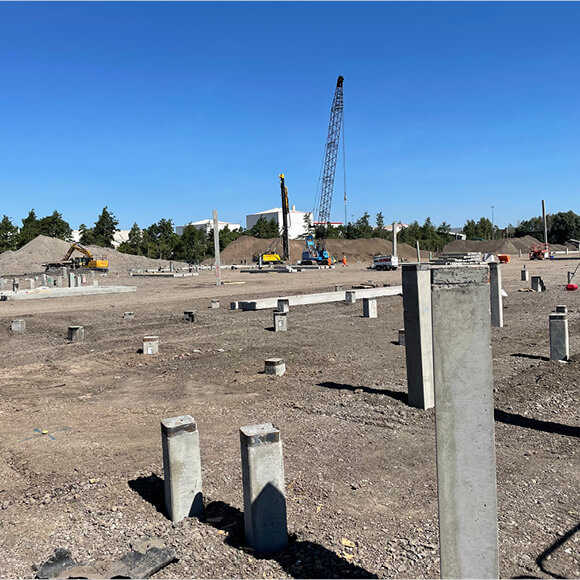
Tensar’s mechanically stabilised platform using T-Value design and geogrid reduced granular material by 40%, cut costs by 60%, while shortening construction time by 40%.
How Tensar can support ground improvement projects
This guide has explored the importance of soil and aggregate compaction, the process, and key factors for successful installation. We've also reviewed common testing methods and ways to overcome challenges in infrastructure projects.
Tensar's free software, Tensar+, assists designers in optimising pavements, foundations, and temporary platforms. By using the T-Value methodology, Tensar solutions enhance load distribution and improve constructability in challenging ground conditions. Incorporating Tensar geogrids helps develop efficient solutions that reduce costs and improve long-term performance.
If you have an upcoming project, get in touch today and submit your project details. We'll provide a complimentary "Application Suggestion" outlining how Tensar solutions can help improve ground performance, reduce material requirements, and lower overall project costs.