Reducing Carbon Emissions in Construction
Date: October 23, 2026
The construction industry accounts for roughly 39% of global energy-related carbon emissions. Faced with tightening government regulations, growing client demands for sustainable development, and ambitious net-zero targets, the sector is under unprecedented pressure to transform its practices. This guide provides a comprehensive overview of practical strategies, innovative material solutions, and design methods for reducing carbon emissions in construction across every phase of a project.
- Where do construction carbon emissions come from?
- How to reduce carbon emissions on a construction site
- Designing for lower carbon from the start
- Applications where carbon can be reduced
- Measuring carbon reductions in construction
- The carbon impact of traditional groundworks
- Gallions Phase 3b piling mat achieves a 144-tonne carbon saving with Tensar
- Reducing construction carbon emissions with Tensar
Where do construction carbon emissions come from?
Construction projects generate carbon emissions at every stage, from the production and transportation of materials to the use of machinery on site. Understanding where these emissions come from can help identify opportunities to reduce them through more efficient design, material use and more sustainable construction methods. In this section, we'll explore the key sources of carbon emissions in construction.
Materials
The materials used on a construction site can make a significant contribution to its embodied carbon. Materials such as concrete, steel and aggregates require extraction, processing and manufacturing before they reach site, with further emissions generated through transportation and installation.
Reducing the quantity of material required can therefore help lower a project's overall carbon footprint. For infrastructure projects, where large volumes of aggregate may be required, using materials more efficiently can reduce the emissions associated with their production, transportation and placement.
Transport
Construction materials and equipment may need to travel considerable distances to and around a project site. Projects that require large quantities of aggregate can involve significant numbers of HGV movements, while excavated material may also need to be transported off site and replaced with imported materials. Reducing the amount of material required can help reduce more than its embodied carbon. Using fewer materials can mean fewer deliveries, fewer vehicle movements and lower fuel consumption.
Earthworks
Earthworks can have a significant impact on a construction project's carbon footprint. Excavating unsuitable or weak ground, transporting it away and importing replacement materials can increase material use, transport requirements and the amount of construction activity needed. Reducing the amount of excavation and imported material required can help lower these impacts.
Where ground conditions and project requirements allow, making better use of site-won materials and stabilising existing ground can reduce the need for excavation and replacement. Considering earthworks at the design stage can also help identify opportunities to reduce carbon before construction begins.
Machinery
Machinery is essential for construction activities such as excavation, grading, material handling and compaction. However, the fuel and energy required to operate machinery contribute to construction-related emissions. Reducing the amount of construction activity required in the first place can help minimise machinery use and its associated emissions.
Energy and waste
From powering machinery and site facilities to processing, handling and installing materials, energy is used throughout the entire construction process. Construction waste can also add to emissions through its transportation and disposal, as well as the production and delivery of replacement materials.
Making better use of materials and finding opportunities to reuse them can help reduce waste and the demand for new materials. Reusing suitable site-won or recycled materials can also reduce the amount of material transported to and from site.
How to reduce carbon emissions on a construction site
Reducing carbon emissions on a construction site involves more than changing how energy is generated or machinery is operated. The design and construction methods used can influence material requirements, excavation and the transportation of materials to and from the site. Considering these factors simultaneously can help identify opportunities to reduce emissions while still meeting the required engineering and performance criteria.
Material usage
Reducing the quantity of material required can lower the emissions associated with its production, transportation and installation. This can be particularly valuable on infrastructure projects where large volumes of aggregate are required. Making better use of suitable site-won and recycled materials can also reduce the need for new materials – all while limiting the amount of waste leaving the site.
At the Cleave Hill Solar Plant project, low-strength subgrade soils and high construction traffic created challenges for the construction of access roads. Tensar developed a one-layer geogrid solution that allowed the aggregate thickness to be reduced while maintaining the required performance. The solution reduced the amount of aggregate material required by 39%, saving 1,230m³ of aggregate and reducing construction CO₂ emissions by 31% compared with the non-Tensar solution. It also reduced construction traffic on local rural roads and delivered a 27% cost saving.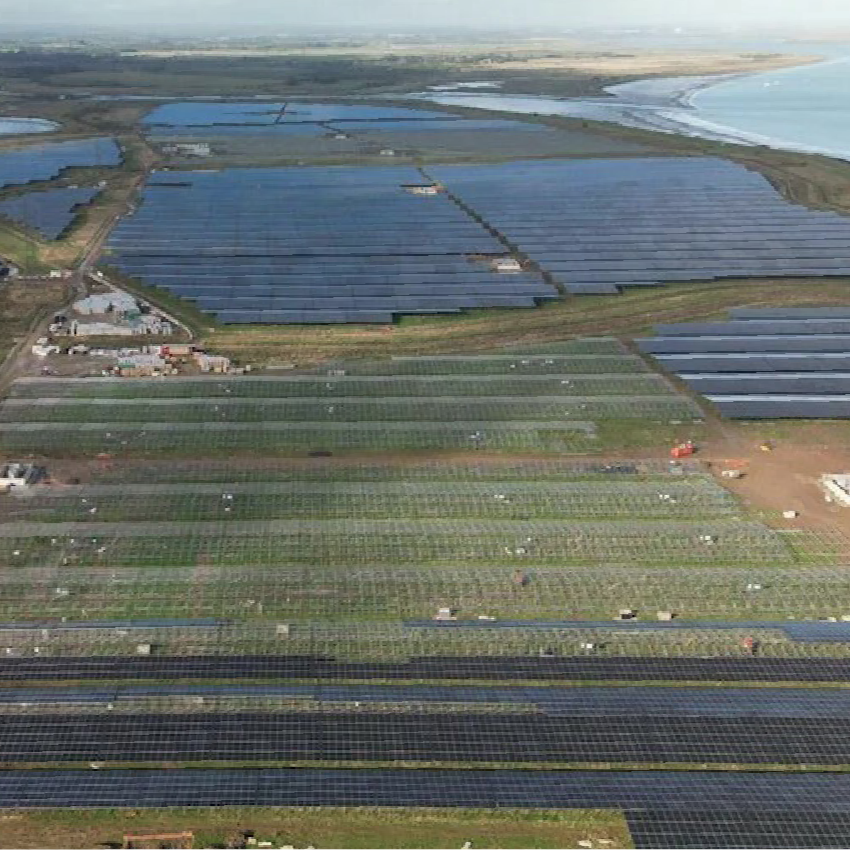
Tensar’s geogrid solution reduced aggregate use by 1,230m³ and construction CO₂ emissions by 31% at Cleve Hill Solar Plant.
Excavation
Excavating and replacing unsuitable ground can increase the amount of material required on a construction project, while also creating additional transportation and disposal requirements. Where weak or variable ground is present, working with the existing ground conditions can help reduce these impacts.
Ground stabilisation and reinforcement techniques can provide an alternative to extensive excavation and replacement, where ground conditions and project requirements allow. This can reduce the amount of material removed from site while also limiting the need for imported aggregate.
Design efficiency
The design of a construction project can have a significant influence on the resources required to deliver it. Considering material quantities, ground conditions and construction methods at an early stage can help identify opportunities to achieve the required performance with a more efficient solution. For infrastructure projects, this could include reducing aggregate layer thickness, improving the performance of existing ground or selecting a construction method that requires less material.
At the HS2 Stoneleigh Park, variable subgrade conditions and high piling rig track pressures required a working platform that could support the planned operations. Using the updated T-Value method with Tensar InterAx, a mechanically stabilised solution was designed with a reduced stone depth. This resulted in an estimated saving of £250,000 in construction costs, 15 days of construction time and 100,000kg CO₂e in carbon emissions.

Tensar’s geogrid solution reduced stone depth by around 1m and estimated carbon emissions by 75% at HS2 Stoneleigh Park.
Transportation
Moving materials to, from and around a construction site can add to a project's carbon footprint, particularly where large quantities of aggregate are required. The distance materials travel, the volume transported and the number of journeys needed can all affect emissions.
Reducing material quantities, reusing suitable materials and limiting excavation can reduce the number of deliveries to site and loads removed from it. This can help lower transportation emissions, particularly on projects where materials need to travel long distances or site access is restricted.
Designing for lower carbon from the start
The greatest potential to shrink a project's carbon footprint is locked in long before breaking ground. By evaluating environmental impacts alongside cost, performance, and constructability during the initial design phase, teams can discover smarter alternatives. These early choices help minimise material quantities, optimise existing ground conditions, and reduce heavy excavation and transportation needs.
Beyond the immediate build, proactive planning drives a true whole-life approach to sustainability. Designing an asset that uses fewer resources upfront and demands less maintenance over its lifespan drastically cuts both the initial construction emissions and the long-term carbon penalty of future repairs or replacements.
Applications where carbon can be reduced
Different construction applications present different opportunities to reduce carbon. The choice of construction method can influence the amount of material required, excavation, transportation and long-term maintenance of a project. Tensar geosynthetic solutions are used across a range of infrastructure applications, helping engineers optimise designs and make more efficient use of materials.
Tensar can help reduce carbon across a range of applications, including:
By reducing the amount of material required, it can have wider benefits beyond the material itself. Fewer materials can mean fewer deliveries and ultimately, minimised construction activity, helping to lower the overall carbon footprint of a project.
Measuring carbon reductions in construction
To prove that design choices and site practices are actually making a difference, the construction industry must move beyond estimations and rely on rigorous measurement. Tracking carbon output turns sustainability goals into quantifiable, actionable metrics. Read on to discover the most accurate ways to measure carbon reductions in construction.
Setting a baseline
Effective carbon reduction relies on accurate data from the outset. Before construction begins, project teams must calculate the anticipated carbon footprint of a standard, "business as usual" design. This initial figure provides the vital benchmark against which all material substitutions, design optimisations, and site practices are compared, ensuring reported savings are genuine and measurable.
Tracking embodied carbon in materials
The bulk of a project's climate impact often lies in embodied carbon—the emissions generated from extracting, manufacturing, and transporting building materials. Utilising carbon calculators and Environmental Product Declarations (EPDs) allows procurement teams to accurately compare suppliers and choose low-carbon alternatives for high-impact materials like steel and concrete.
Utilising Life Cycle Assessments (LCAs)
True measurement looks beyond the handover date. A Life Cycle Assessment (LCA) evaluates an infrastructure's environmental impact from material extraction through to its eventual demolition and recycling (cradle-to-grave). Integrating LCAs into the planning phase allows developers to measure how long-term durability and energy efficiency will offset initial construction emissions over the next 50 to 100 years.
The carbon impact of traditional groundworks
Despite the industry's push for sustainability, many projects still default to the conventional approach when faced with poor soils. This business as usual mindset carries a compounding carbon penalty that is often ignored in favour of tweaking above-ground designs. For teams evaluating how to reduce carbon emissions on a construction site, challenging these inherited groundwork practices is one of the most effective places to start.
The true environmental impact of traditional methods creates a domino effect of emissions that extends far beyond the site boundaries:
The over-engineering penalty
Defaulting to deep excavation means stripping away existing soils rather than working with them. When we look at how to reduce embodied carbon in construction, engineering out these unnecessarily thick layers of imported primary aggregate is one of the biggest, yet most frequently missed, opportunities.
The schedule multiplier
Traditional groundworks are inherently slow. Every extra week spent excavating, waiting for material deliveries, and compacting deep fill means another week of diesel-powered machinery continuously running on site.
Local infrastructure strain
The heavy reliance on exporting spoil and importing stone doesn't just create direct tailpipe emissions. The sheer volume of HGV traffic degrades local road networks and creates congestion, amplifying the project's wider environmental footprint.
Moving away from the standard approach by adopting mechanically stabilised layers is a highly effective method for reducing carbon emissions in construction. It stops this domino effect at the source, allowing engineers to achieve the required performance by working with the ground rather than against it.
Gallions Phase 3b piling mat achieves a 144-tonne carbon saving with Tensar
At the Gallions Phase 3b development in London's Royal Docks, the installation of an 8,000m² piling mat alongside the Thames posed a significant logistical and environmental challenge. The initial design required over 1.2 metres of imported fill to overcome the site's poor ground conditions. This traditional approach would have generated high material costs and a heavy carbon footprint due to the thousands of heavy truck movements needed to transport aggregates through congested city streets.
Tensar designed a mechanically stabilised layer using its T-Value design method and a single layer of Tensar InterAx geogrid. This engineered approach safely accommodated heavy plant loads while achieving a 65% reduction in platform thickness compared to the original specification. By drastically reducing the need for deep excavation and imported fill, the project saved £314,000 in construction costs, shortened the programme by 30 days, eliminated 1,700 truck movements, and prevented an estimated 144 tonnes of carbon emissions.
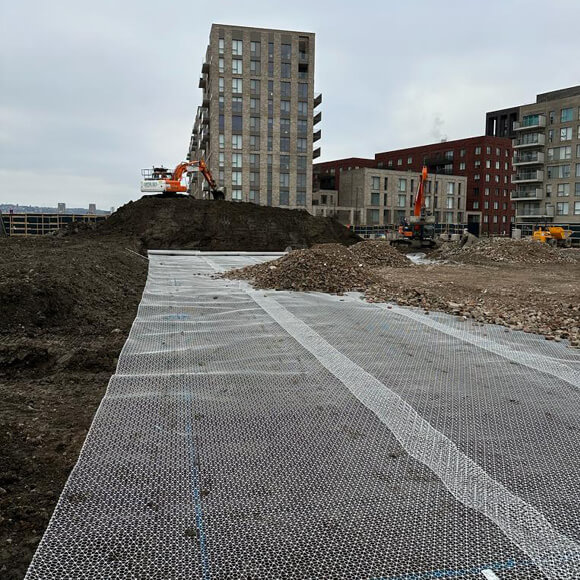
By incorporating Tensar InterAx geogrid, the Gallions Phase 3b project eliminated the need for deep excavation, saving £314,000 and 144 tonnes of carbon.
Reducing construction carbon emissions with Tensar
This guide has explored the key sources of carbon emissions in construction and how early design choices can significantly lower a project's environmental footprint. We've also looked at the carbon impact of traditional groundworks, the importance of accurate measurement, and ways to overcome these challenges using more sustainable construction methods.
By incorporating Tensar geogrids into your project, you can reduce aggregate volumes, limit heavy excavation, and cut transport emissions while maintaining structural performance.
If you have an upcoming project, get in touch today and submit your project details. We'll provide a complimentary 'Application Suggestion' outlining how Tensar solutions can help lower carbon emissions, optimise ground performance, and reduce overall construction costs.
Tensar's free geotechnical software, Tensar+, can help optimise designs to reduce a project's carbon footprint by assessing ground conditions and developing efficient mechanically stabilised layers
Learn more