Ground Improvement: Techniques, Designs & Its Importance
Date: April 28, 2026
Construction projects today often face challenging ground conditions that can cause safety, performance, and cost-efficiency issues. Weak or highly variable soils can lead to serious problems like differential settlement, compromising the stability and longevity of structures if left untreated. Traditional approaches, such as deep excavation or importing large volumes of engineered fill, can be costly, time-consuming, and environmentally disruptive.
Modern ground improvement techniques are transforming the way engineers are tackling these challenges. By enhancing soil properties, these methods can increase strength, stiffness, and bearing capacity to create safer and more reliable structures. However, unexpected site conditions, restricted access, and higher upfront costs all play a role in determining which ground improvement technique is most suitable for a construction project. Careful planning, thorough site assessment, and informed design choices are essential to ensure the best results.
In this guide, we’ll take a comprehensive look at what ground improvement is, the techniques used, key applications, and design considerations. We’ll also explore how it can enhance project performance, along with the challenges of ground improvement and how to manage these risks to deliver long-term value on construction projects.
Looking for something in particular? Use the links below to navigate straight to it:
Looking for ground improvement solutions?
Contact us to see how we can add value when you’re faced with challenging ground conditions.
Learn more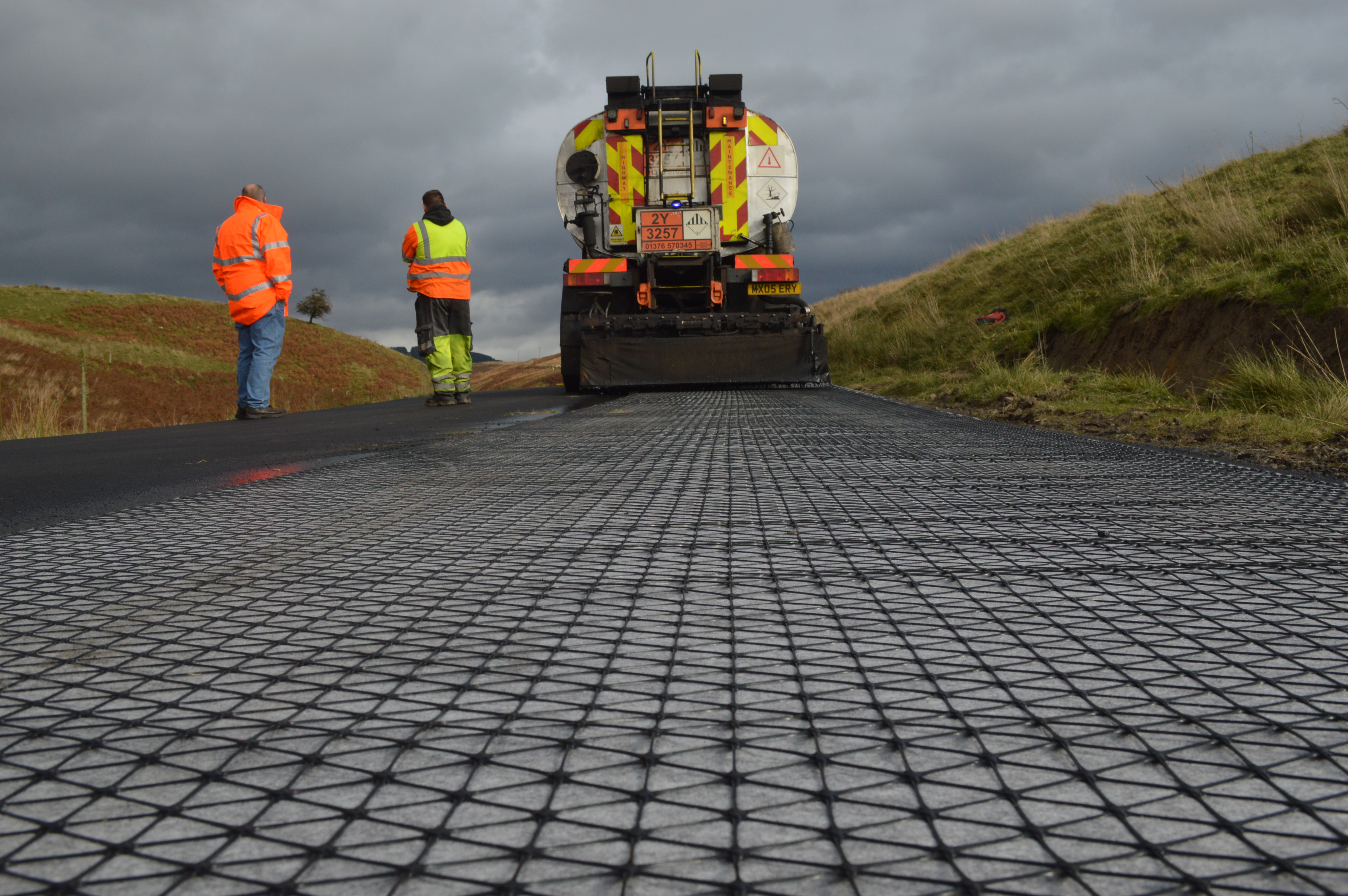
What is ground improvement?
Ground improvement is the process of enhancing the natural properties of soil to make it stronger, more stable and suitable for construction projects. Many soils encountered on construction sites, such as soft clay, loose sand, or fill materials, may have low strength, high compressibility, or uneven settlement behaviour. If left untreated, these soils can compromise the safety and durability of structures built on them. Ground improvement techniques essentially aim to modify soil properties by increasing shear strength, reducing compressibility, and controlling settlement.
Ground improvement vs ground stabilisation
Although the terms are sometimes used interchangeably, ground improvement and ground stabilisation refer to slightly different approaches to enhancing soil performance.
Ground improvement is any technique used to enhance the natural properties of soil, such as increasing strength and reducing settlement. This often includes mechanical, chemical, or structural methods to make the ground more suitable for construction. On the other hand, ground stabilisation is a specific type of ground improvement that focuses on treating soil to mitigate movement or failure, usually by binding particles together or addressing weak layers. Techniques involve chemical stabilisers, cement mixing, and installing geogrids.
Overall, ground stabilisation is a form of ground improvement, but not all ground improvement techniques are stabilisation.
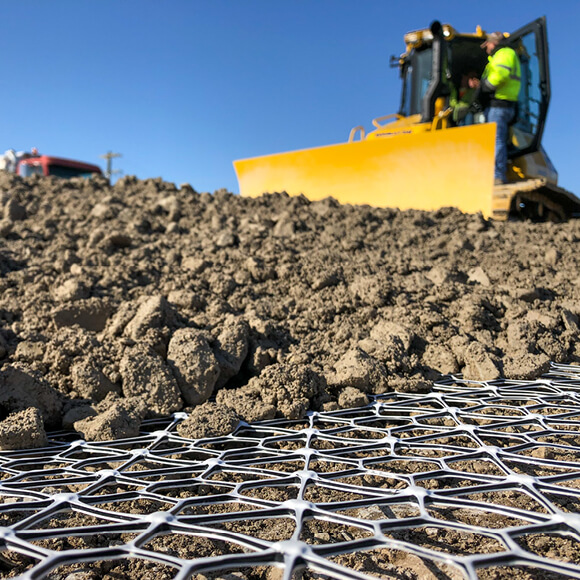
A close-up image of ground stabilisation using Tensar InterAx® geogrid.
Ground improvement techniques
A variety of ground improvement techniques can be used to enhance the soil performance and create reliable conditions before construction begins. However, the choice of method depends on the soil characteristics, the type of structure, and load requirements. Below, we explore the main ground improvement techniques commonly applied in geotechnical engineering.
Mechanical compaction
Mechanical compaction is one of the most widely used ground improvement techniques and is typically applied to near-surface soils. It’s most effective in granular soils, such as sand and gravel, where compaction can significantly increase density. This method is commonly used in applications like road construction, embankments, and shallow foundations, as it improves the soil’s bearing capacity while reducing the risk of settlement.
Soil stabilisation and reinforcement
Through the use of soil stabilisation and reinforcement methods, ground conditions can be improved by altering the soil’s physical or chemical properties or by introducing materials that strengthen its structural performance. Chemical stabilisation typically involves mixing binders such as lime or cement into the soil. These materials react to the soil particles to increase shear strength, reduce plasticity, and improve bearing capacity, resulting in a firmer and more stable ground structure. In contrast, geogrid stabilisation can provide a mechanically stabilised layer that interlocks with aggregate, spreading loads efficiently and reducing deformation. Geogrids can be installed quickly, are suitable for a wider range of soils, and often allow thinner base layers, making them ideal for working platforms, embankments, and trafficked areas where ground support is needed.
Deep soil mixing
Deep soil mixing mechanically blends binders, such as cement or lime, directly into the ground to form columns or panels of stabilised soil. This is particularly effective in very soft, wet, or contaminated soils, creating structural support elements while reducing soil permeability. As a modern, highly controlled method, deep soil mixing allows precise improvement of soil properties and can be tailored to specific load-bearing requirements.
Drainage
Managing groundwater is an essential part of improving soil performance, which is why drainage can play a key role in many ground improvement projects. Excess water in the soil can significantly reduce its strength and increase compressibility, making it less able to support structural loads. Techniques such as vertical drains or sand drains are commonly used to accelerate consolidation in soft clay soils.
Deep foundations
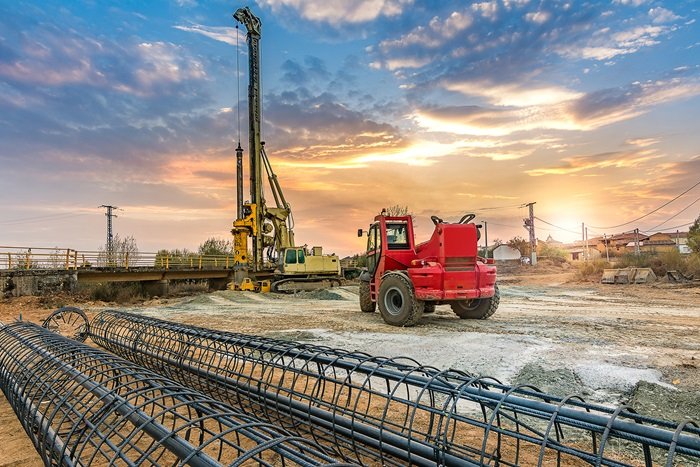
When shallow ground improvement is insufficient, deep foundations are used to transfer structural loads to stronger strata at depth. Piling is typically used, providing stability where weak or compressible soils cannot support loads on their own. While technically a foundation technique rather than pure soil modification, deep foundations are considered part of the broader ground improvement strategy when dealing with weak ground conditions.
.jpg)
Building foundations with a rotary bored piling rig
Applications of ground improvement
Ground improvement techniques are widely used in different types of construction applications to ensure stability while enhancing soil performance. By strengthening weak or variable grounds, these methods can allow geotechnical engineers to build safely and efficiently – even on the most challenging sites.
Some of the key areas where ground improvement is commonly applied include:
Road construction, including paved and unpaved roads
Shallow foundations
Retaining structures and embankments
These applications demonstrate how improving the ground can provide a reliable and durable foundation for a wide range of construction projects.
How ground improvement enhances project performance
Construction on weak or variable soils often involves significant earthworks, excavation, and material handling. By utilising ground improvement techniques, not only can sites be safer and more stable, but they can also improve efficiency and reduce project risks. Below, we’ll take a closer look at how these methods can enhance project performance.
Improves load-bearing capacity
Weak or loose soils can limit the types of structures that can be built, or they can require costs and complex foundations to stabilise them. By using ground improvement techniques, the soil strength and stiffness can be improved, enhancing the overall load-bearing capacity. The outcome of this means engineers can design more efficient foundations while reducing the need for extensive excavation and reinforcement. Strengthening the soils and load-bearing capacity can also provide a more predictable performance, making construction safer and lighter foundation designs that save both time and cost.
Reduces construction delays
When there are unstable or poorly performing soils on a construction site, it can cause project delays. Improving the ground before construction begins can help mitigate these risks. Not only does it keep timelines on track, but it also helps reduce the risk of costly disruptions or redesigns during more critical phases of the project. By stabilising the soil in advance, engineers can avoid unexpected settlements or foundation issues that might otherwise halt progress.
In the North Heybridge Estate Road project, the construction of a new road needed a pavement design capable of meeting the CD225 foundation class to allow the Essex County Council to adopt the carriageway. Tensar assessed the site and determined the required thickness for a Mechanically Stabilised Layer (MSL) design using Tensar InterAx geogrid to meet the foundation requirements – even with construction occurring over low-strength subgrade. The Tensar-stabilised capping layer reduced the quantity of granular fill needed and minimised the amount of excavation required. Overall, this resulted in a total of 12 days (50%) reduction in construction time.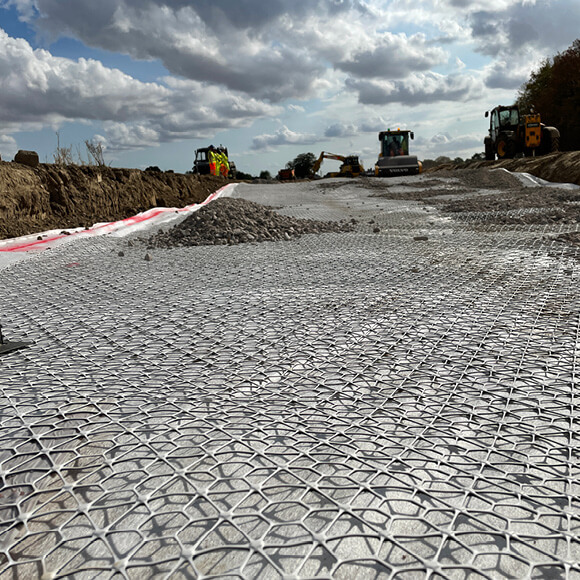
Tensar used a mechanically stabilised layer incorporated with InterAx geogrids at North Heybridge Estate Road, reducing construction time by 12 days (50%).
Mitigates differential settlement
Another key advantage of ground improvement is its ability to mitigate differential settlement. By stabilising the soil and creating a more uniform foundation, it ensures that all areas of a site respond consistently to applied loads. Differential settlement can occur when different parts of the structure settle at different rates, leading to cracking, misalignment, and long-term structural issues. Implementing ground improvement techniques can help minimise uneven movement while improving the overall load distribution. Not only is the performance and lifespan of the project enhanced, but it also reduces the maintenance requirements.
Minimises project costs
While ground improvement can require some high upfront costs, it’s often more economical to invest in the site earlier on rather than dealing with problems after the construction begins. Treating weak soils early can reduce the need for extensive remedial work and avoid structural damage. Optimising the soil’s performance can also reduce the amount of aggregates required, further lowering construction costs.
The Green Park project required working platforms in two areas of the site of the new Primary Academy in King’s Lynn, to enable ground improvement at the start of construction. Underlying peat and clay soils were highly variable and weak in places, with undrained shear strengths as low as 9kPa – falling outside BR470 platform design guidance. Tensar’s T-Value method was used to produce designs for the working platforms based on rig loadings, soil conditions and granular fill grading. The two platforms were built using 6F1 aggregate, mechanically stabilised with Tensar geogrids. This resulted in 35% savings in construction costs, as well as 50% savings in embodied carbon.
The Tensar T-Value method was used to design working platforms at Green Park, saving 35% on construction costs.
Design considerations for ground improvement
Designing effective ground improvement starts with a thorough assessment of site conditions and project requirements. Proper planning not only ensures safety and cost efficiency, but it can also extend the life of the structure. Read on to explore the key factors to consider when designing ground improvement approaches and how these decisions can impact the overall success of a project.
Type and depth of soil
The type and depth of soil at a site can highly influence which is the most suitable ground improvement method. Weak or cohesive soils, such as clay or peat, often require deep soil mixing or preloading to achieve the desired stability. In contrast, granular soils can often be improved effectively through compaction techniques. Understanding the soil's variability and layer thickness can help in the process of selecting the most efficient and cost-effective method on a construction site.
Anticipated loads and settlement
Ground improvement designs must carefully consider the type and magnitude of loads the site will support. Predicted settlement under these loads should be minimised to prevent damage to structures like foundations and pavements.
Using specific techniques, such as chemical stabilisation or mechanically stabilised layers, can help distribute loads more evenly and control differential settlement. By tailoring the ground improvement method to the expected loading conditions, a more reliable foundation on site can be achieved – reducing the risk of structural distress over the life of the project.
Maintenance and design life
The expected lifespan and maintenance requirements of a project are key factors when selecting a ground improvement method. Techniques should be durable enough to support the structure over its full design life while minimising the need for regular maintenance. For example, you’ll need to consider whether an access road will carry heavy traffic regularly or only serve temporary construction vehicles. By considering both the frequency of use of the structure along with the bearing capacity of the traffic, the chosen ground improvement method can be decided to enhance the lifespan of the project.
Environmental restraints
Environmental and regulatory requirements can strongly influence the choice of ground improvement methods. Projects may be subject to local planning regulations or may have sustainability targets that could restrict the use of certain ground improvement techniques, such as deep excavation.
The chosen ground improvement method needs to not only meet the technical requirements but also promote sustainable construction methods and comply with local regulations. Considering environmental constraints early on in the design process can help to avoid delays by accounting for additional time for approvals – all while ensuring the project aligns with broader sustainability goals.
Book a free design consultation
Unsure which ground improvement solution is right for your next project? Get in touch with our team for a free design consultation.
Get in touch
Managing risk in ground improvement projects
While ground improvement can deliver multiple structural and performance benefits, it can still come with its own set of challenges. Read on to explore these issues and how to mitigate the risks associated with ground improvement methods.
Weak soil conditions
Extremely weak variable soils can present some complex engineering challenges. In some cases, treatments may not provide sufficient improvement in ground conditions, requiring deeper solutions such as piled foundations. Highly variable ground conditions can also make performance less predictable, increasing the need for detailed site investigations and testing. A thorough geotechnical assessment is essential to ensure the selected ground improvement method effectively addresses the strength, stability and settlement requirements.
Limited site access
Restricted working areas can significantly affect the chosen ground improvement method. Some techniques require heavy and vibration-intensive equipment, while others may need a large supply of materials delivered to the site. This would require heavy equipment and transportation to move back and forth across access roads, which may not be feasible at certain sites. In these cases, alternative approaches for smaller rigs or lower-impact methods may be used instead.
At the Eastleigh railway depot project, subgrade conditions were weaker than anticipated within a confined operational rail environment. The subgrade had a CBR or 0.8% while the expected minimum was 3.4%. Limited working space and access restrictions ruled out large-scale excavation and heavy ground improvements. Tensar’s mechanically stabilised layer (MSL), incorporating Tensar InterAx geogrids, was provided – improving load distribution and a suitable bearing surface for construction activities. This approach reduced construction time by 42%, saved an estimated 20% in material costs and 35% savings in embodied carbon.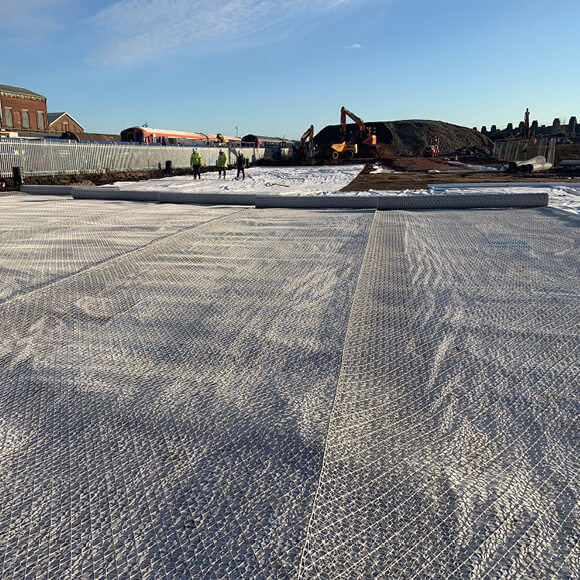.png?width=580&height=580&ext=.png)
At Eastleigh Railway Depot, Tensar used a mechanically stabilised layer (MSL) combined with Tensar InterAx geogrids to address the limited site access and avoid large-scale excavation.
Upfront costs
Some ground improvement techniques involve higher upfront costs compared to minimal or temporary treatments. While in the long run, ground improvement can be cost-effective, the upfront costs can be difficult to manage if there is a limited project budget. Specialist equipment, sourcing materials, and the amount needed can increase early-stage costs. However, these investments deliver long-term value by reducing settlement risks, avoiding structural damage, and lowering maintenance requirements over their lifespan.
At the ETEX factory extension project in Bristol, poor ground conditions required a ground improvement solution capable of supporting construction loads without excessive excavation. Platform thickness had to be reduced from the initial designs and be fully constructed from recycled aggregates reclaimed from within the site. Tensar achieved a 60% reduction in platform thickness compared to the initial proposals using the illustrative calculation method described in BR470. The Tensar mechanically stabilised platform, incorporating a Tensar stabilisation geogrid, was designed using the Tensar “T-Value” approach. This resulted in an estimated 27,500m3 (40%) reduction in granular material and £270,000 (60%) in construction costs.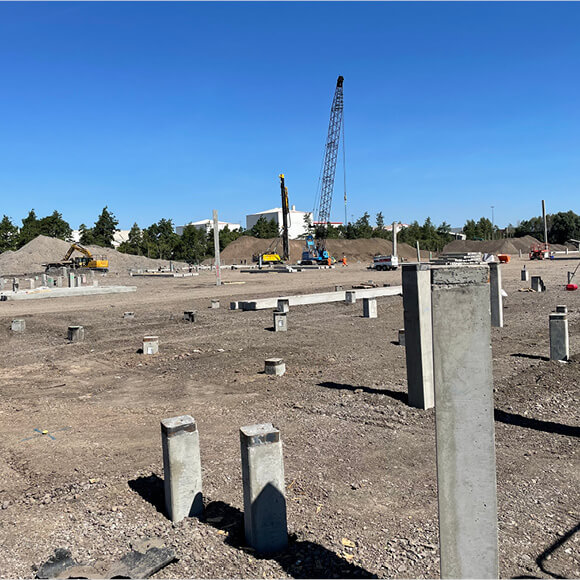
Tensar used a mechanically stabilised platform incorporated with stabilisation geogrids at the ETEX factory extension, saving an estimated £270,000 (60%) in construction costs.
Ground improvement case study: Lomeshaye Industrial Estate
At the Lomeshaye Industrial Estate in Nelson, UK, the original chemical stabilisation approach proved ineffective due to unexpectedly wet, low‑strength soils and construction plant action that essentially liquefied the existing ground, halting progress. The contractor required a reliable and cost‑efficient ground improvement solution to support concrete slab construction without further delay.
Tensar’s solution was to design and install a Mechanically Stabilised Layer (MSL) incorporating Tensar InterAx geogrid directly over the existing wet and low-strength soils. This MSL provided the engineered stiffness and bearing capacity needed for the subsequent construction works. Performance testing on top of the stabilised layer confirmed that the design targets were achieved, enabling the project to proceed on programme without traditional chemical treatment or extensive excavation.
Tensar InterAx geogrid was used at Lomeshaye Industrial Estate to stabilise weak, wet soils and support construction.
How Tensar can support your next ground improvement project
This guide has introduced you to ground improvement, the different techniques that can be used and the key design considerations. We’ve also explored how ground improvement can enhance project performance, along with how to overcome any risks associated with ground improvement.
Our free geotechnical Tensar+ software can support the design of ground improvement solutions, helping you optimise material use and develop efficient, buildable designs. By incorporating Tensar geogrids within mechanically stabilised platforms and foundation systems, you can improve load distribution and enhance overall project performance.
If you have an upcoming project involving poor ground conditions, get in touch today and submit your project details. We’ll provide a complimentary “Application Suggestion” outlining how our ground improvement solutions can help reduce risk, control costs, and deliver long-term value.