.png?width=400&height=400&ext=.png)
Robroyston revisited: six years on, Stratum is still performing
Date: June 25, 2026
In this episode of Tensar Ground Coffee, I returned to one of my favourite projects: the Robroyston embankment in Glasgow. It is a scheme that stands out not just because of the difficult ground conditions, but because it is such a good example of what can be achieved when the right ground improvement solution is selected early and designed properly. Several years on from construction, it was very satisfying to go back, stand on the finished road, and see just how well the solution has performed.
The project formed part of Glasgow City Council’s wider development proposals for a new park and ride railway station and access road connection serving the Robroyston area. The challenge was that the embankment had to be built over a brownfield site underlain by made ground, glacial clay and, crucially, frequent non-uniform peat pockets. These peat pockets were the real problem. Peat is highly compressible anyway, but when it occurs irregularly in isolated pockets, the bigger concern is not just settlement itself, but differential settlement across and along the embankment.
Why peat pockets are worse than peat
That is something I touched on in the video: what is worse than peat? Peat pockets. If all the ground settles by a similar amount, that is one issue. But when some areas settle much more than others, the road profile starts to distort. In practice, what road users experience is not simply the amount of differential settlement, but the rate at which that settlement changes along the road. In engineering terms, that is the curvature of the road profile. If the curvature becomes too great, ride quality is affected and long-term serviceability becomes a concern due to adverse effects on road drainage and pavement cracking.
Traditional solutions considered for the site included excavation and replacement, vibro techniques, deep soil mixing and piled options. Piling had already been ruled out as too expensive, and although soil mixing had been considered, the client wanted to explore whether a more efficient alternative could deliver the required performance. That opened the door for Tensar’s Stratum ground improvement solution.
The Stratum solution
At Robroyston, the adopted solution was a 1.3 m deep cellular foundation mattress, now known as TensarTech® Stratum®, installed beneath the embankment. The system comprised multiaxial polypropylene geogrid at the base, with HDPE uniaxial geogrids forming the cells, creating a stiff three-dimensional mattress filled with granular material. Its function was to spread load more evenly onto the weak and variable foundation soils, reducing the severity of differential settlement and improving serviceability of the embankment over time.
One of the particularly attractive aspects of the Robroyston scheme was that the Stratum mattress was filled using recycled demolition material, equivalent to Type 6F2 fill. That reduced the need for high-quality imported aggregate and helped lower the overall carbon footprint of the project. It also provided drainage benefits, while avoiding the need for the kind of heavy ground treatment plant associated with deep mixing techniques.
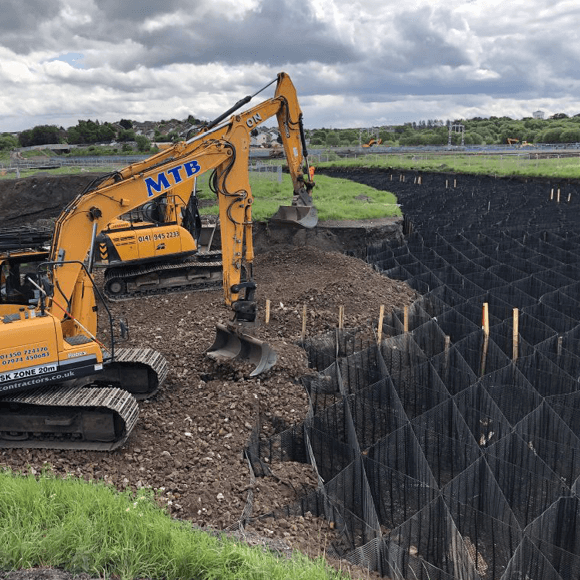 The project underway at Robroyston
Designing for serviceability, not just survival
A key point in this project was that the design did not stop at asking whether the embankment could stand up. The more important question was whether it would remain serviceable over time on such variable ground. To assess this properly, finite element modelling was carried out using PLAXIS 3D, considering a range of geological scenarios to reflect uncertainty in the extent and thickness of peat across the site. The modelling looked not only at total settlement, but also at the resulting settlement profile and curvature along the road.
The analyses showed that the 1.3 m high Stratum mattress reduced differential settlement across the embankment width by around 11–12% and reduced maximum slope deflection near the culvert by around 23%. Importantly, when the predicted long-term settlement profile was converted into road curvature, the values were found to remain below the limit associated with acceptable user comfort over the whole alignment.
This is where Stratum really comes into its own. On sites like this, the challenge is not simply one of ultimate bearing capacity; it is managing variable support conditions so that the embankment behaves in a controlled, predictable way despite the weak and inconsistent foundation below. That is exactly what the mattress system was designed to do. 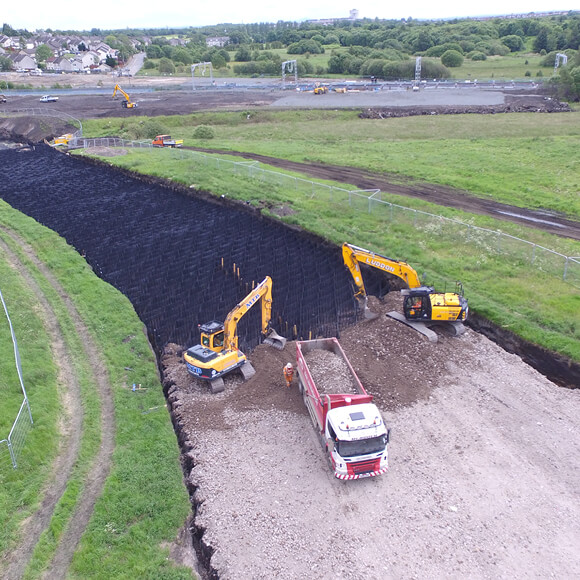 Under construction: A representative view of a cellular foundation mattress being filled and compacted over weak ground.
Saving cost while improving constructability
The original proposals involved far more intensive intervention, including deep ground improvement or piles. By adopting the Stratum solution instead, the project achieved cost savings of more than £500,000 compared with alternative ground improvement measures. That is a substantial reduction, but just as importantly, it was achieved without compromising performance.
There were also clear construction benefits. The mattress could be formed with relatively straightforward site operations and no specialised plant or construction techniques. This is often where value engineering is most effective: not just cutting upfront cost, but selecting a solution that is simpler to build, more sustainable in material use, and better aligned with the real performance requirements of the asset. Robroyston is a very good example of that.
But did it actually work?
That is always the key question, and it is one of the reasons I wanted to revisit the site. During and after construction, the embankment performance was monitored using hydrostatic profile gauges (HPGs), and the measured settlements during the first monitoring period were found to fall within the predicted range from the design analyses. The settlement rate was initially faster than predicted, but then eased earlier, suggesting the foundation soils were draining more readily than assumed in the model—entirely plausible on a site with such variable ground conditions.
To provide further assurance, satellite-based InSAR monitoring was later used to track post-construction movements. The InSAR assessment concluded that the observed settlements remained within the range predicted for the different geological scenarios considered in design, and that no further remedial settlement measures were required.
When I returned to site about six years after construction, the visual evidence was very encouraging. Looking down the kerb line, the profile appeared smooth and regular, exactly what you want to see on a scheme where differential settlement was the principal concern. Most of the settlement that was ever going to happen had already occurred, and the embankment was clearly performing well. From an engineering point of view, that is deeply satisfying: the analysis predicted acceptable behaviour, the monitoring confirmed it, and the real asset now demonstrates it in service.
See my simple experiment below, showing the benefits of a geosynthetic cellular foundation mattress
A good example of early collaboration
The Robroyston embankment is also a reminder of the importance of early engagement between client, designer and contractor. The project team did not simply default to the heaviest or most traditional ground treatment option. Instead, they looked carefully at the actual problem to be solved—controlling long-term differential settlement over variable peat pockets—and selected a system tailored to that problem. The result was a solution that was technically robust, commercially attractive, easy to build and materially more sustainable.
For me, this project remains a genuine Tensar triumph: challenging ground, a smart design approach, significant savings for the client, and—most importantly—a road embankment that is still performing very well years later.