.jpg?width=400&height=400&ext=.jpg)
What Is Geogrid & How Does it Work?
Date: April 09, 2026
Geogrids have revolutionised civil engineering. Modern infrastructure, from highways and railways to airport runways and retaining walls, relies on strong, stable ground. Yet, natural soils are often too weak or inconsistent to carry heavy loads without significant improvement. By using geogrids, design engineers can stabilise soils quickly, cost-effectively, and sustainably.
In this in-depth article, we will explore the world of geogrids, from their invention to their diverse applications. Additionally, we will examine the unique contributions of companies like Tensar and provide a practical guide to geogrid installation and maintenance.
Here for something specific? Use the links below to find what you're looking for.
- What is a geogrid?
- What is a geogrid used for?
- The benefits of geogrid
- What are the types of geogrids?
- How does a geogrid work?
- Geogrid applications
- How geogrid differs from other soil reinforcement materials
- The Tensar differences
- How Tensar geogrids save time and money on construction projects
Tensar geogrids can be used to solve civil and geotechnical engineering problems in or on the ground. They help design engineers to achieve substantial time- and cost-savings across a range of applications, from working platforms to all project foundations. If this could be of use for your upcoming project, speak to our team today.
What is a geogrid?
Geogrid is a type of geosynthetic material that provides a stabilisation and reinforcement function to aggregates and soils. The design features a two-dimensional rib pattern creating apertures or open spaces that allow geogrid reinforcement and stabilise. This geogrid structure integrates well with the surrounding materials, improving overall performance. Compared to other geogrids, Tensar geogrids are manufactured with a high rib profile and highly efficient junctions. This deeper 3-dimensional profile creates a confinement effect, essentially locking the aggregate in place rather than just letting it sit on top.
Unlike a fabric that primarily acts as a separator or filter, a geogrid is built to interact with the fill placed on it, improving bearing capacity and reducing rutting, settlements and differential movement under traffic and structural loads.
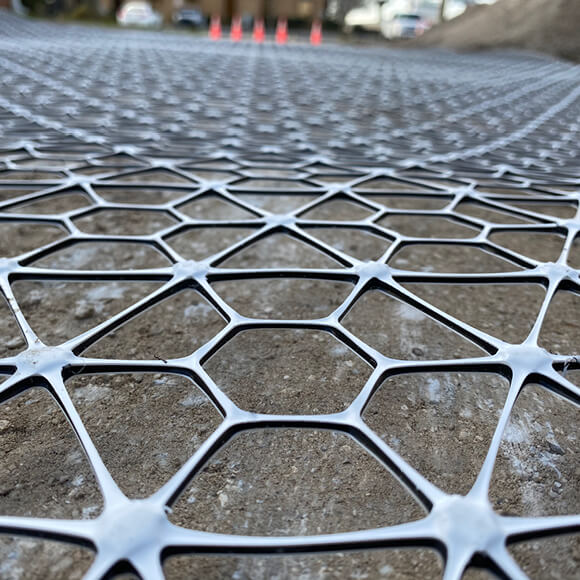 A closer look at Tensar® InterAx® (NX) Geogrids
What materials are geogrids made from?
Most commercial geogrids are made from durable polymers that can withstand soil chemistry, construction damage and long-term loads. Polypropylene (PP) and high-density polyethylene (HDPE) are commonly used for punched-and-drawn geogrids (where a sheet is perforated and stretched to orient the polymer), delivering high tensile stiffness at low strains and excellent chemical resistance. Some geogrids are also made from Polyester (PET).
The choice of polymer and manufacturing method affects tensile properties, junction strength, aperture stability, durability and how effectively the geogrid interacts with the chosen fill.
Tensar geogrids are typically manufactured from oriented HDPE or PP for durability, stiffness and strength.
Who invented geogrids?
Geogrids were invented by Dr Frank Brian Mercer and patented in 1978. Prior to its acquisition, Mercer founded the company Netlon, which went on to become Tensar. Continuing the tradition of innovating geosynthetics, Tensar still stands today as the world leader in geogrids, investing in the research and development of new products such as Tensar® InterAx®.
To learn more, read our brief history of Tensar geogrid or see our booklet on Dr Frank Brian Mercer and the invention of polymeric geogrids.
What is a geogrid used for?
1. Ground stabilisation
When placed within or at the base of a granular layer, a stiff geogrid interlocks with the aggregate, limiting lateral spreading and dilation under load. The result is a stiffer, stronger composite layer, referred to as a Mechanically Stabilised Layer or MSL, that carries traffic more efficiently, reduces rutting, and can often allow a thinner aggregate layer to achieve the same performance. This is widely used for unpaved roads, working platforms, subgrade improvement, and pavement foundations.
2. Reinforcement
In retaining walls and reinforced steep slopes, geogrids act as tensile reinforcement within compacted fill, creating a mechanically stabilised earth (MSE) mass that resists outward movement. Uniaxial geogrids are commonly used in these gradient/separation systems, with both design and construction governed by well-established guidance.
3. Separation layer
While geotextiles are the classic separators, geogrids can contribute to separation by keeping aggregates from punching into weak subgrades and by maintaining aggregate structure through interlock. Many designs combine a geotextile (for filtration/separation) with a geogrid (for stabilisation/reinforcement) when subgrades are very soft or water movement must be controlled.
For advanced soil stabilisation and reinforcement solutions, consider Tensar® InterAx® geogrid.
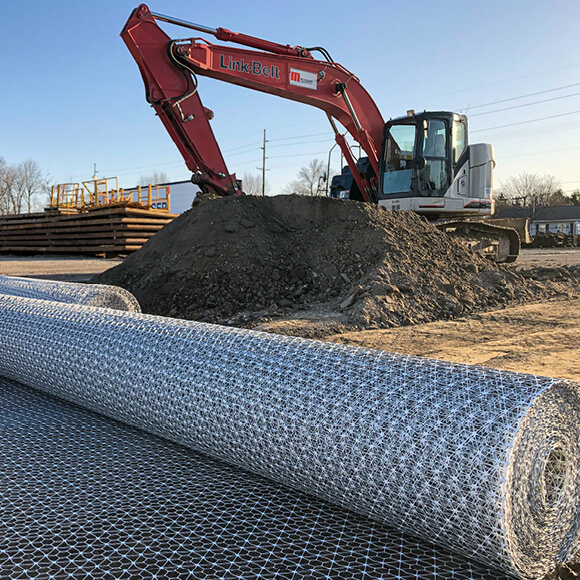 Subgrade stabilisation with Tensar® InterAx® (NX) Geogrids
The benefits of geogrid
The use of geogrids offers numerous benefits in construction projects, making them a cost-effective and efficient solution:
- Cost-effectiveness: Geogrids can reduce the amount of aggregate fill needed by up to 50%, leading to significant savings in material costs and transportation. Their simple installation also reduces labour costs and construction time.
- Enhanced structural integrity: By stabilising the aggregate, geogrids create a more resilient foundation for roads, working platforms, and rail trackbeds, while providing essential reinforcement for retaining walls and steep slopes. This leads to increased load-bearing capacity and a longer lifespan for infrastructure, significantly reducing future maintenance costs.
- Environmental sustainability: Using geogrids can reduce the need for extensive excavation and the quarrying of new aggregate materials. This minimises the environmental impact of construction and can lead to a smaller carbon footprint.
- Versatility: Geogrids can be used in a wide range of applications, from constructing roads over weak soils to building retaining walls and stabilising slopes.
What are the types of geogrids?
Geogrids are primarily categorised based on their manufacturing process and the direction of their tensile strength:
- Uniaxial geogrid: This is the most advanced geosynthetic made for soil reinforcement. Uniaxial geogrid is made from select grades of high-density polyethylene (HDPE) resins.
- Biaxial geogrid: This is the original geogrid for construction over weak soils, invented by Tensar in the 80s. Biaxial geogrids provide high strength in two directions due to their bidirectional grid structure.
- TriAx®: An evolution beyond biaxial technology, TriAx® features a hexagonal structure with triangular apertures. Rather than focusing on simple tensile strength, TriAx® is designed for mechanical stabilisation, creating a more efficient transition of stress from the aggregate to the geogrid.
- Tensar InterAx®: The latest advancement in Tensar’s technology, InterAx® (including the H-series), represents the pinnacle of geogrid performance. By leveraging advanced material science and optimised 3D geometry, InterAx® provides superior particle confinement. This makes it Tensar's best-performing geogrid for mechanical stabilisation in roads, working platforms, rail trackbeds, and other trafficked areas.
Read more: Geogrids Types & Their Physical Properties
 Tensar® TriAx® (TX) Geogrids
How does a geogrid work?
A geogrid works through particle confinement and mechanical interlock. When a load is applied to a mechanically stabilised soil layer, the geogrid and soil act as a single composite material. The geogrid's open apertures confine particles, allowing them to mechanically interlock with the grid's ribs, forming a mechanically stabilised layer of soil and preventing lateral movement.
Rather than relying on a tensioned membrane effect, modern stabilisation geogrids work through lateral restraint. The aggregate particles become interlocked within the geogrid apertures, creating a confinement effect. This interaction increases the shear strength of the aggregate layer, making it significantly more resistant to lateral displacement and permanent deformation.
By confining the particles, the geogrid creates a mechanically stabilised layer that distributes applied loads over a much wider area of the subgrade. This improves the overall stiffness and bearing capacity of the platform or road pavement, leading to a more durable structure and a longer service life.
Explore how a geogrid performs: Geogrid performance and design
Read more: Soil Stabilisation: Methods & Products
Geogrid applications
Geogrids are used in a variety of civil engineering applications, including:
- Roads, pavements & surfaces: Used for subgrade stabilisation and base stabilisation in flexible and rigid pavements, parking lots, and unpaved roads to reduce rutting and extend pavement life.
- Walls & slopes: They are the primary reinforcement element in Mechanically Stabilised Earth (MSE) walls and steepened slopes, where they increase the stability and load-bearing capacity of the soil backfill.
- Foundations & embankments: Geogrids are used to improve the stability of foundations for structures and to support embankments built over weak or compressible soils.
- Rail: Ballast and sub-ballast stabilisation to reduce fouling and settlement, improving track geometry retention and tamping intervals.
- Working platforms: Geogrids are used to ensure the safety of a construction site, especially in the heavy use of mobile cranes, piling rigs and other heavy plant machinery.
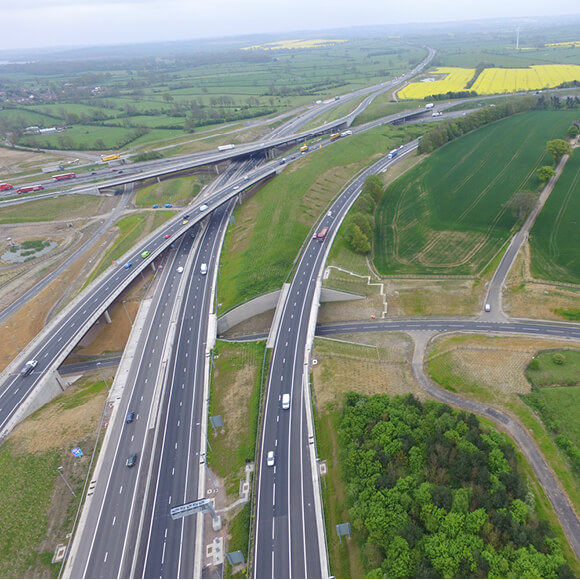 Geogrids can be used for roads, pavements and trafficked areas
How geogrid differs from other soil reinforcement materials
Geogrids are part of a broader category of materials called geosynthetics, which also includes geotextiles and geocells. While all geosynthetics are used to solve geotechnical problems, they have different functions.
Geogrids vs. geotextiles
Geogrids are primarily used to reinforce or stabilise soils and aggregates. In roads and trafficked areas, they provide mechanical stabilisation through interlocking and confinement with the aggregate. In contrast, for applications such as retaining walls and steep slopes, they provide soil reinforcement, where the geogrid's high tensile strength is the primary driver of structural stability.
Geotextiles, on the other hand, are permeable fabrics used mainly for separation, filtration, and drainage. They can also provide some reinforcement, but generally don’t provide as much tension as geogrids.
Read more: Geogrids vs Geotextiles: What're the Differences? | Tensar
Geogrids vs. geocells
Geogrids are 2D planar structures, while geocells are 3D honeycomb-shaped cellular confinement systems. Geocells work by completely encasing the infill material, providing a higher level of confinement and making them suitable for use with a wider range of soil types, including fine-grained soils.
Stabilisation geogrids rely on the interlocking of aggregate within the grid's apertures to provide lateral restraint; they are therefore most effective when used with granular, coarse-grained soils. In these applications, a Tensar stabilisation geogrid acts as a high-efficiency confinement mechanism, creating a mechanically stabilised layer at a low installation cost.
In contrast, reinforcement geogrids (such as those used for walls and slopes) rely primarily on their tensile properties and stiffness to manage soil stress and provide long-term structural stability.
The Tensar difference
Tensar offers proven, high-performance geosynthetic products and systems, primarily including geogrids, that help you deliver your project with confidence. Not only do they provide significant benefits over alternative solutions, but they’re also widely accepted by client authorities worldwide and have had their performance proven and quantified by extensive research and field trials. What really makes Tensar different is the level of service, expertise and support available.
The range of geosynthetic products and systems Tensar offers includes:
- Tensar® InterAx® Geogrids
- Tensar® TriAx® Geogrids
- Tensar® TriAx® Geocomposites
- Tensar® Uniaxial Geogrids
- Tensar® Biaxial Geogrids
- Tensar® Basetex® Geotextile
- Tensartech® Reinforced Soil Retaining Walls and Slopes
- Tensartech® Stratum System
How Tensar geogrids save time and money on construction projects
Tensar geogrids offer a cost-effective alternative to traditional ground improvement, stabilising the ground to create a mechanically stabilised layer. This saves time and materials, particularly for projects facing weak ground, where conventional methods would cause delays and extra costs. We have two projects that illustrate these benefits:
Three Bridges Solar Farm
The challenge
The Three Bridges Solar Farm project in Norfolk faced a major challenge with its access roads. The ground was incredibly soft, with a California Bearing Ratio (CBR) as low as 2%, meaning it couldn’t support the weight of construction vehicles.
Our solution
To solve this, the client was facing high extra costs and delays to strengthen the roads. By using Tensar® InterAx® geogrid, the team was able to create a stabilised access road with less aggregate. This solution not only reduced the amount of material required but also cut down on vehicle deliveries, saving time, money, and fuel.
For more on this project, visit the full Three Bridges Solar Farm.
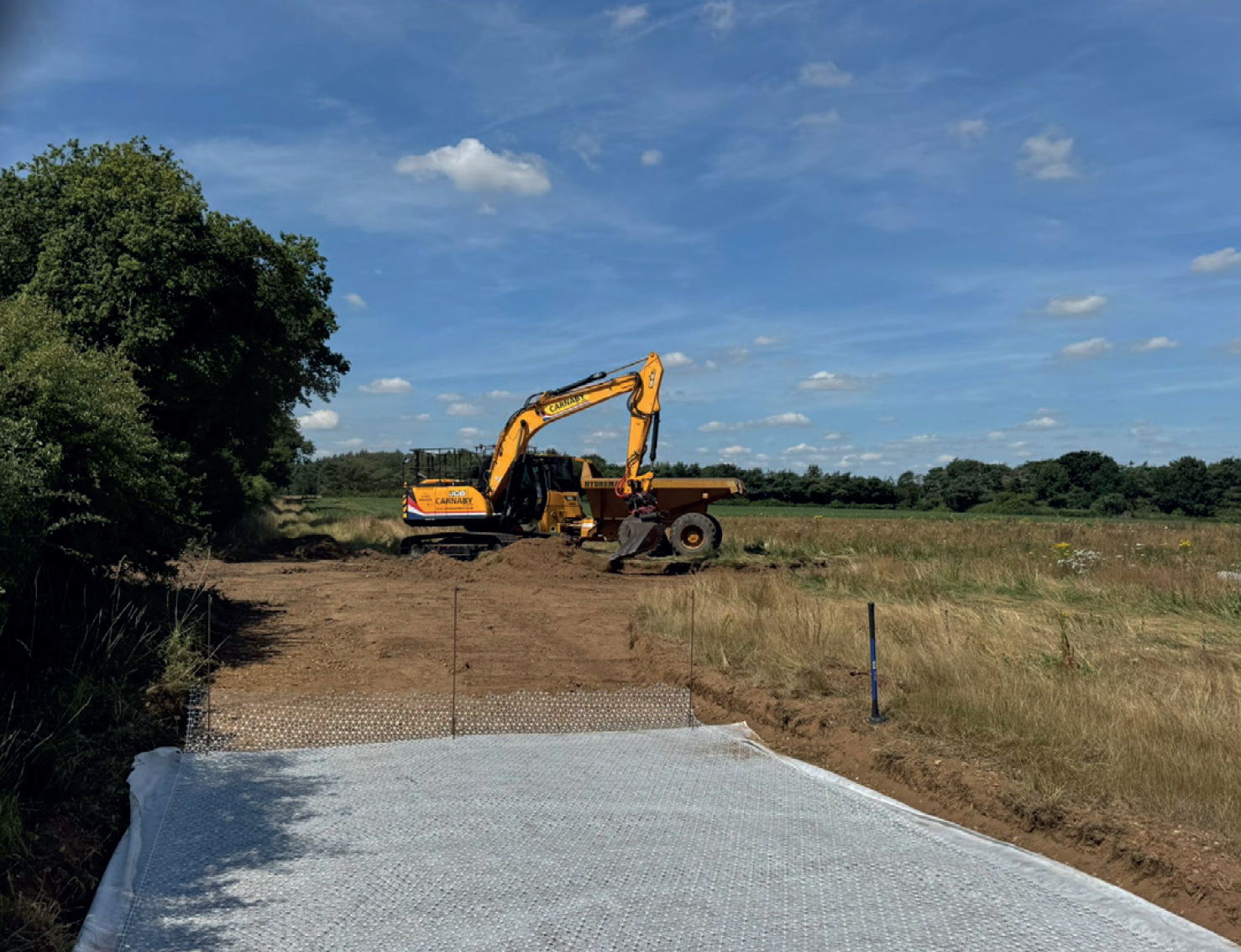 Three Bridges Solar Farm
Eastleigh Railway Depot
The challenge
When building the Eastleigh Railway Depot, the client encountered a significant problem: the subgrade soil was much weaker than anticipated (CBR of 0.8% instead of the expected 3.4%). This called for a quick and reliable solution to create both a working platform and a stable foundation for the permanent concrete slab.
The solution
By providing a Tensar Mechanically Stabilised Layer (MSL) with Tensar® InterAx® geogrid, the project team addressed the varying loading conditions of the construction sequence. The solution led to an estimated 42% reduction in construction time and a 20% saving in material costs, along with a 35% reduction in embodied carbon.
Read the full Eastleigh Railway depot for more details.
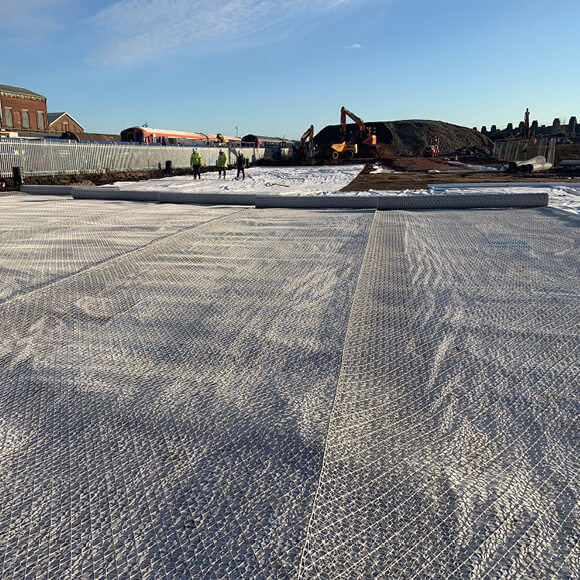.png?width=580&height=580&ext=.png) Eastleigh Railway Depot
Eastleigh Railway Depot
Reduce project timelines and costs with Tensar geogrid
The right ground stabilisation solution ensures your project stays on schedule and within budget.
Tensar's innovative geogrid technology is designed to do just that, offering a smarter, more sustainable, and more cost-effective way to build. Whether you're dealing with weak soil, short deadlines, or a tight budget, a Tensar geogrid solution can provide the stability and support you need.
To learn how we can help with your next project, contact us today.
Topics:
- Rail Track Improvement
- Working Platforms
- Renewables
- Commercial & Industrial
- Foundations & Embankment Support
- Reinforced Soil Retaining Walls & Slopes
- Roads & Highways
- Housing & Residential
- Rail
- TriAx® (TX)
- TriAx® (TX-G)
- Biaxial (SS)
- Uniaxal (RE500)
- Flexible pavements
- Airports
- Tensar InterAx (NX)
- Tensar H-Series (HX)