.png?width=400&height=400&ext=.png)
In Istanbul with Terzaghi: revisiting the foundations of soil mechanics
Date: June 26, 2026
Karl von Terzaghi is widely regarded as the father of modern soil mechanics, and for good reason. Before Terzaghi, engineers certainly built foundations, retaining walls and embankments, but much of the design relied on precedent, rules of thumb and experience rather than a rigorous understanding of how soils actually behave. Terzaghi changed that by bringing theory and practice together and turning soil behaviour into something that could be analysed, tested and applied in real design.
That is why recording this episode of Tensar Ground Coffee in Istanbul felt particularly appropriate. Istanbul was not just another stop in Terzaghi’s career. It was one of the places where modern soil mechanics was effectively born. Terzaghi taught first at what is now Istanbul Technical University from 1916 to 1918, and then at Robert College in Istanbul from 1918 to 1925. It was during these years in Istanbul that he carried out the thinking, experimentation and early development work that led directly to his landmark 1925 book, Erdbaumechanik auf bodenphysikalischer Grundlage — the publication widely regarded as the birth of modern soil mechanics.  Karl von Terzaghi, 1926
Terzaghi’s route into geotechnics was not a straightforward one. Born in Prague in 1883 and educated in Graz, he originally studied mechanical engineering and then worked on civil engineering and hydroelectric projects in Central and Eastern Europe. That practical site experience exposed him to a recurring problem that engineers still recognise today: structures are only as good as the ground they sit on, and ground conditions are often the least certain part of the job. Terzaghi became increasingly interested in bridging the gap between geology, mechanics and engineering judgement. Rather than accept soil as an inconvenient unknown, he set out to understand it scientifically.
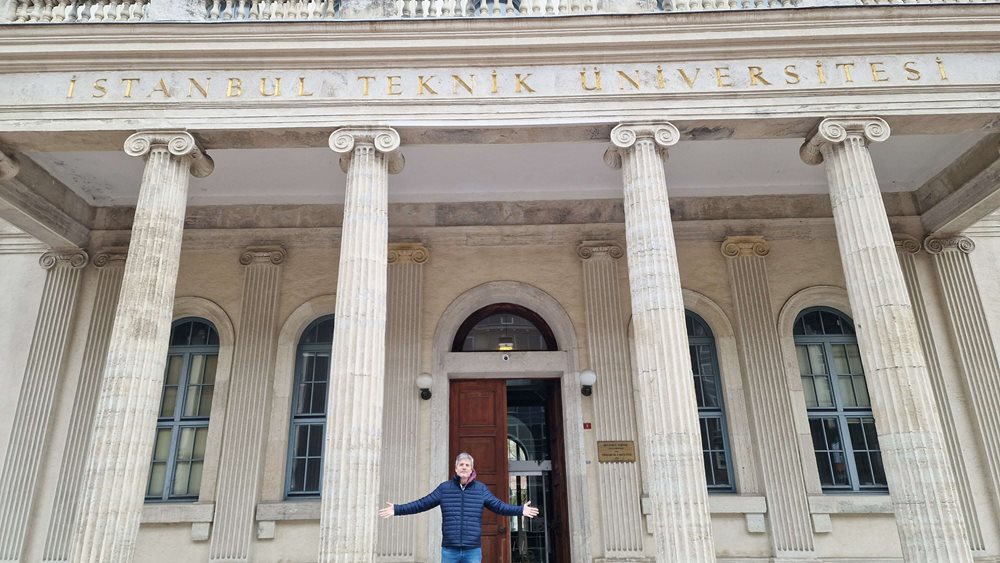 Revisiting the foundations of soil mechanics at Istanbul Technical UniversityWhat made Terzaghi so important was not simply that he published a textbook. It was that he gave the profession a coherent framework for understanding soil behaviour. His work introduced and developed concepts that remain fundamental to geotechnical engineering today, including effective stress, consolidation, bearing capacity, earth pressures and slope stability. In other words, he helped explain not only how soil carries load, but also how water within the soil influences strength and deformation over time. These ideas still sit at the heart of how we assess settlement, stability and foundation performance on projects around the world.
One of the things I have always admired about Terzaghi is that he was not a purely academic engineer. He cared deeply about solving real problems. In fact, one of the reasons his work had such a lasting impact is that it was rooted in observation, testing and practical application. Even in Istanbul, he worked with very simple apparatus and improvised experimental setups, yet the insights he derived from them transformed the profession. That, to me, is a useful reminder that good geotechnical engineering does not begin with software or complexity — it begins with understanding the mechanisms that control behaviour in the ground.
Istanbul is therefore much more than an atmospheric backdrop for a video. It is part of the story. Terzaghi himself later referred to Robert College in Istanbul as the place where he “laid the foundations for soil mechanics,” and sources from both Istanbul Technical University and the Turkish geotechnical community continue to highlight how formative those Istanbul years were. Recording a Ground Coffee episode there is a small nod to the city’s place in our profession’s history.  The warship in the image is captured navigating the Bosphorus Strait in Istanbul, Turkey. This exact setting played a monumental role in Terzaghi’s life and the birth of geotechnical engineering:
Terzaghi’s influence only grew after he left Istanbul. In 1925 he moved to MIT, later held the chair of soil mechanics in Vienna, and eventually went on to Harvard, while also consulting on major projects across the world. His ideas were not universally accepted at first — as is often the way with new thinking — but they gradually reshaped engineering practice. He also became the first President of what grew into today’s International Society for Soil Mechanics and Geotechnical Engineering (ISSMGE), helping to establish soil mechanics not as a niche interest, but as a global engineering discipline in its own right.
That makes the upcoming 21st International Conference on Soil Mechanics and Geotechnical Engineering (ICSMGE 2026) in Vienna especially significant. The conference organisers have chosen the slogan “Where it all began”, because Vienna will mark 100 years since the publication of Terzaghi’s 1925 book, and because the first Institute and Laboratory for Soil Mechanics was established at TU Wien in 1929. It is a fitting tribute. Modern geotechnical engineering has evolved enormously over the last century — from hand calculations and small-scale apparatus to advanced constitutive models, numerical analysis, remote sensing and big data — but it still rests on foundations laid by Terzaghi.
For those of us working in geotechnics today, Terzaghi’s legacy is not simply historical. It is present in the questions we ask on every project. How is load transferred into the ground? What controls short-term and long-term settlements? How do water pressures change the response of soil? How do we distinguish between apparent strength and real stability? These are Terzaghi questions. Whether we are designing foundations, stabilising working platforms, assessing embankments, modelling reinforced soil or trying to understand field performance, we are still building on the framework he created.
So, as this Ground Coffee episode looks back at Karl von Terzaghi from Istanbul, it is really doing two things at once. It is recognising one engineer’s immense contribution to the profession, and it is reminding us that geotechnical engineering has a rich history worth revisiting. A century on from Erdbaumechanik, that history still feels very current.
The tools may have changed, but the fundamental challenge remains the same: understanding the ground well enough to engineer with confidence. Terzaghi gave us the language, principles and mindset to do exactly that.