.jpg?width=400&height=400&ext=.jpg)
Geotechnical Risks: Assessments, Mitigation & Management
Date: July 01, 2026
Construction projects are often exposed to geotechnical risks due to weak and variable ground conditions. Weak soils and complex subsurface conditions can create uncertainty in a project, potentially impacting safety, delivery times and long-term structural performance. Without proper understanding and control of site conditions, these risks can lead to differential settlement, costly construction delays, and even structural failure.
While ground conditions are difficult to fully predict, effective geotechnical investigation and design can help reduce this uncertainty. By identifying potential hazards early and applying appropriate design solutions, engineers can improve load-bearing behaviour and reduce deformation, enhancing safety and supporting more reliable construction outcomes. Modern approaches, including ground improvement and geogrid solutions, are helping to make construction on challenging sites more predictable and efficient.
In this guide, we’ll explore what geotechnical risk is, why early assessment is essential, and the most common types of ground-related hazards encountered on construction projects. We’ll also look at how these risks can be managed and mitigated to overcome them.
Looking for something in particular? Use the links below to navigate straight to it:
Save time and mitigate geotechnical risks on your next project with our free geotechnical design software, Tensar+
Learn more
What are geotechnical risks?
Geotechnical risks are uncertainties associated with ground conditions that can negatively impact a construction project. These risks stem from natural, variable subsurface factors, like weak soils or high groundwater, leading to issues such as foundation settlement, slope instability, or excavation collapses.
Ground conditions can vary across a construction site, making it difficult to predict how soils will behave during construction and throughout the design life. If these site conditions are not properly assessed, geotechnical risks can lead to differential settlement issues, deformations, movements, large settlement, ground instability, and structural failure.
Geotechnical risk assessments
Ground conditions can be one of the biggest uncertainties in construction projects. A geotechnical risk assessment is a structured process used to identify ground-related hazards, evaluate their likelihood and consequences, and define appropriate measures to control or reduce their impact on design and construction.
The assessment is typically built on information from site investigations and a conceptual ground model, which is used to understand key ground behaviour. This includes the variability in soil properties, groundwater conditions, and potential instability mechanisms. From this, risks are assessed using engineering judgement and numerical analysis to estimate the likelihood of ground failure.
The outcomes are then recorded within a geotechnical risk register, where each risk is ranked and linked to appropriate mitigation actions such as design adjustments, construction controls, or monitoring requirements. This structured approach allows project teams to manage uncertainty more effectively and maintain control over ground-related performance throughout the project lifecycle.
Common types of geotechnical hazards
Understanding the most common types of geotechnical hazards is essential for identifying potential risks early. Below, we explore the key ground-related challenges that can affect construction projects.
Differential settlement
When a structure settles into the ground uniformly, it rarely causes major structural damage. The real danger is differential settlement, when one part of a structure sinks faster or deeper than the rest. This can occur when an unpaved road sits on variable soils, which squeeze differently over time, causing different sections of the subgrade to sink at uneven rates. The result is poor drainage, unsafe driving conditions, rapid surface degradation, and increased maintenance
Geogrid can be used over variable subgrade soils as part of the unbound layer construction. The resulting mechanically stabilised layer will mitigate differential settlement in the road construction, increasing serviceability and reducing potential maintenance.
Slope instability
If the forces within a slope exceed the ground’s shear strength, it can lead to slope instability. Weak soils, steep gradients, elevated groundwater levels, water penetration, and changes in moisture can increase the risk of movement or failure in embankments and natural slopes.
Bearing capacity failure
Every soil type has a limit on how much weight it can support, known as its bearing capacity. If you place a heavy structure or heavy construction machinery on soft, loose, or poorly compacted soil without first stabilising it, the weight will push the soil out from beneath the foundation. This can cause the structure to sink or tilt dramatically.
Groundwater-related issues
Water is one of the most critical factors influencing ground behaviour on any construction site. High water tables and poor drainage do more than just complicate excavations; they directly impact soil mechanics by increasing pore water pressure (the pressure of water trapped within the voids or 'pores' between soil particles) and reducing soil strength.
When pore water pressure rises, it counteracts the forces holding the soil particles together. This reduces the ground's effective stress and shear strength, neutralising its ability to support heavy structural loads.
Methods for geotechnical risk mitigation
Managing geotechnical risk effectively can help reduce uncertainty, improve safety and support the overall success of the project. Read on to explore the key methods used to identify, manage and minimise geotechnical risks on construction projects.
1. Proper site investigations
A proper site investigation is essential for managing geotechnical risk in construction. This is a structured process of gathering, analysing, and interpreting ground condition data to understand soil variability, strength, groundwater, and potential hazards before design and construction begin.
Typical site investigations include:
Desk studies: Review of existing information such as geological maps, historical records, and previous site data to understand baseline ground conditions.
Field investigation: On-site exploration such as boreholes, trial pits, and in-situ testing to directly assess subsurface conditions.
Laboratory testing: Detailed testing of soil and rock samples to determine engineering properties like strength, density, and soil permeability.
Environmental assessments: Evaluation of contamination risks, groundwater quality, and other environmental factors that may affect the construction or reuse of materials.
These stages work together to develop a reliable ground model that supports safe, efficient design and helps reduce uncertainty and risk during construction.
2. Ground improvement techniques
Ground improvement techniques enhance the performance of weak or variable soils – improving overall ground stability without the need for excessive excavation. Techniques include the use of mechanically stabilised layers (MSL), which incorporate geogrid stabilisation in granular materials to improve load distribution and reduce load transferred on top of the weak ground. Compared to traditional "dig and replace" methods, this can save time and money whilst also offering substantial sustainability benefits through reducing carbon cost.
At the Three Bridges Solar Farm project in Norfolk, the site had very poor ground conditions with CBR values as low as 2%. This meant that geogrid stabilisation was required to support construction access roads and distribute the heavy wheel loads of vehicles passing over them throughout the construction process and maintenance. Tensar InterAx geogrid was used to provide a stabilised access road, reducing the amount of aggregate required and the number of vehicle deliveries to the site. Overall, construction material costs and project delays associated with vehicle movement across the site were minimised.
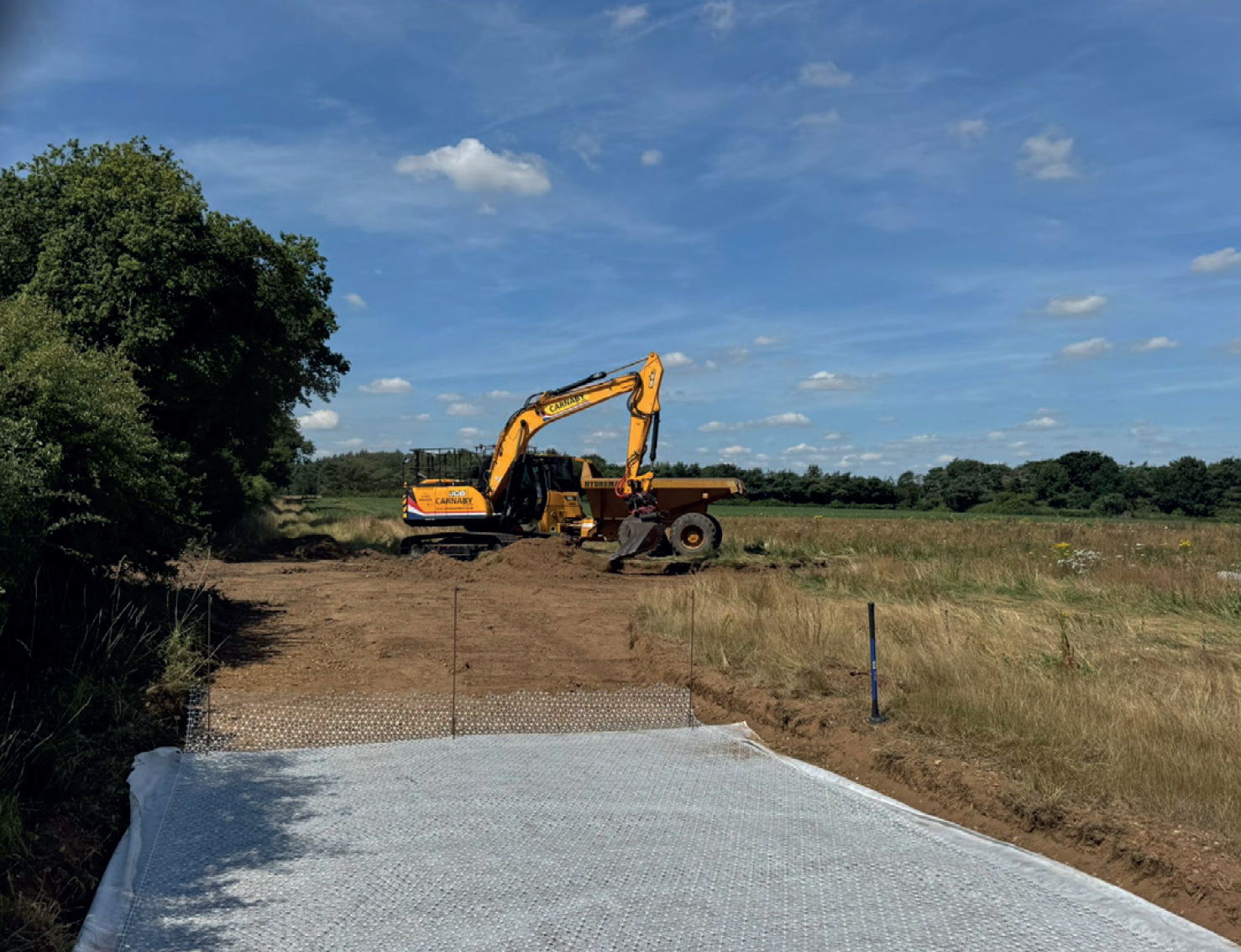 InterAx geogrid was used at the Three Bridges Solar Farm to stabilise weak ground, enabling access roads that reduced aggregate use and construction delays.
3. Structural adaptations
We can manage geotechnical risks by designing structures that work with ground conditions rather than against them. This approach is commonly applied across earthworks and structural systems where there are variable ground conditions, limited space, or low-strength soils.
A key application is the use of geogrid-reinforced soil retaining walls, which provide stable earth retention solutions in areas with limited space, variable soils, or challenging topography. Also referred to as mechanically stabilised earth (MSE) walls, these can reduce the need for carbon-intensive mass concrete structures while speeding up construction and often lowering overall project costs.
Foundation and embankment support systems incorporating geosynthetics are also used where ground conditions require load distribution or reinforcement to improve stability over weaker ground. This helps reduce settlement risk, enhances structural performance, and supports long-term durability across a wide range of infrastructure projects.
4. Reducing geotechnical risks for working platforms
A stable and reliable working platform is essential for creating a safe construction site, especially on sites with weak or variable ground conditions. Poor ground conditions can limit access, reduce productivity and increase health and safety risks if not properly managed. Working platforms can be improved through ground stabilisation techniques such as a geogrid-mechanically stabilised aggregate layer. Not only can this help enhance the load distribution, but it can also increase bearing capacity and reduce deformation under repeated construction traffic.
5. Ongoing monitoring of ground movement
Ongoing monitoring of ground movement is key to managing geotechnical risk during and after construction. It involves continuously tracking changes in ground conditions over time to identify potential instability, settlement, or deformation at an early stage.
Monitoring is typically carried out using a range of geotechnical instrumentation, including surveying techniques, settlement plates, inclinometers, and other embedded sensors. Settlement plates measure downward settlement of the soil layer beneath a surcharge or embankment, while inclinometers track lateral displacement within soil or retaining structures.
This data is used to verify that actual ground behaviour aligns with design predictions and to highlight any movement outside acceptable limits. Where necessary, it enables timely intervention to reduce risk. Continuous monitoring also supports long-term structural performance by ensuring that ground-related changes are identified and managed proactively
Looking for geotechnical risk mitigation solutions?
Contact us to find out how we can help you manage risk and add value when faced with challenging ground conditions. Learn more.

How geotechnical risks continue to impact construction projects
Geotechnical risks still remain a major challenge in construction due to the subsurface conditions rarely being fully predictable at the design stage. Even with detailed investigation, variations in soil behaviour can still lead to unexpected performance issues once works begin. Below, we will explore these issues and how to manage and reduce geotechnical risk in construction projects.
Variable ground conditions
Ground conditions are rarely uniform, and even within a single site there can be significant changes in soil strength, stiffness, moisture content and composition. These ground variations can be difficult to fully capture during a geotechnical risk assessment, leading to weaker areas or inconsistent bearing capacity only being discovered once construction begins. Due to this uncertainty, designs can be less reliable, and there is a risk of differential settlement and even failure of the project's performance.
In the Eastleigh Railway Depot project, subgrade conditions were much weaker than expected from the initial project documentation. Foundation subgrade improvement was required, alongside a working platform and haul road to give construction access over the weaker ground. Tensar used a mechanically stabilised layer incorporating Tensar InterAx geogrid to suit the varied ground conditions. This resulted in the required levels of support throughout construction, creating a 42% reduction in construction time and 20% savings in material costs.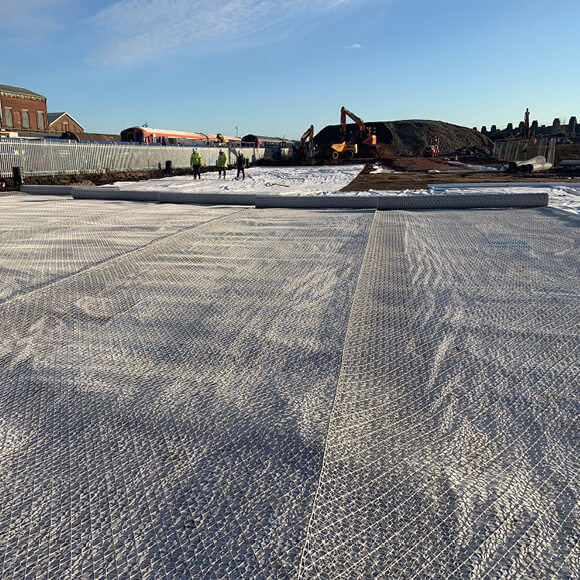.png?width=580&height=580&ext=.png)
A mechanically stabilised layer incorporating Tensar InterAx geogrid was used on the weak subgrade, saving 42% in construction time and 20% in material costs.
Project delays and redesigns
Geotechnical risks are a common cause of delays and cost overruns on construction projects, especially where ground conditions are different from what was expected at the design stage. Unforeseen ground conditions can lead to redesigns – meaning more materials required and increased costs and delays. By addressing potential issues at an early stage, projects can avoid redesigns, minimise disruption and reduce the need for reactive engineering solutions on site.
At the Green Park Primary Academy project, temporary working platforms were needed in two areas of the site to enable ground improvement at the start of construction. The underlying peat and clay soils were highly variable and weak in places, with shear strengths as low as 9kPa, which fell outside BR470 platform design guidance. Tensar's T-Value method using a stabilising geogrid was used to produce the designs for the working platforms based on rig loadings and soil conditions. Overall, the project saved 35% in construction costs and 20% in construction time - keeping down overall project costs and helping to maintain the construction programme despite the challenging ground conditions.
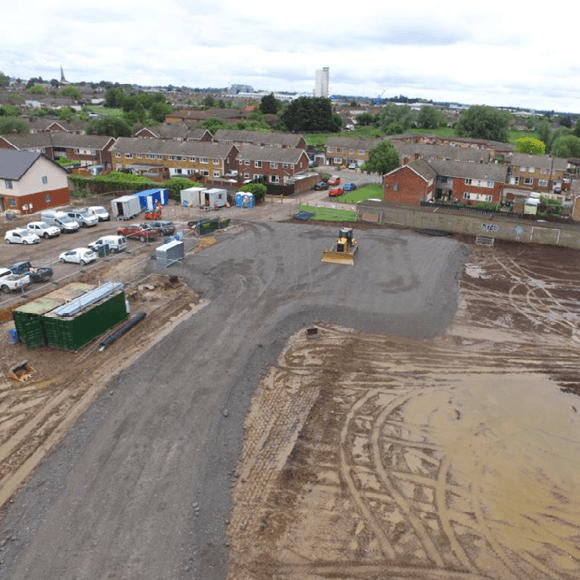
Tensar's T Value method was used on the Green Park project, which had weak and variable ground conditions, saving 20% in construction time and 35% in construction costs.
Environmental impact
Some geotechnical risks can also have an impact on the environment. This is particularly the case when they lead to additional excavation or the need for large volumes of imported materials to make the ground suitable for construction. If weak or varied ground conditions are discovered, the demand for aggregates increases – meaning more transportation movements. As a result, embodied carbon rises and the overall environmental impact of the project is higher than originally planned.
The ETEX factory extension project faced the challenge of weak and variable site conditions, and the platform thickness had to be reduced from initial designs while being fully constructed from recycled aggregates reclaimed from the site. Tensar achieved a 60% reduction in platform thickness when compared to initial proposals by using Tensar's mechanically stabilised platform incorporated with stabilisation geogrids. Recycled material was recovered from the site and used to form the mechanically stabilised platform. This resulted in a 40% reduction in granular materials used and a 50% estimated reduction in embodied carbon.
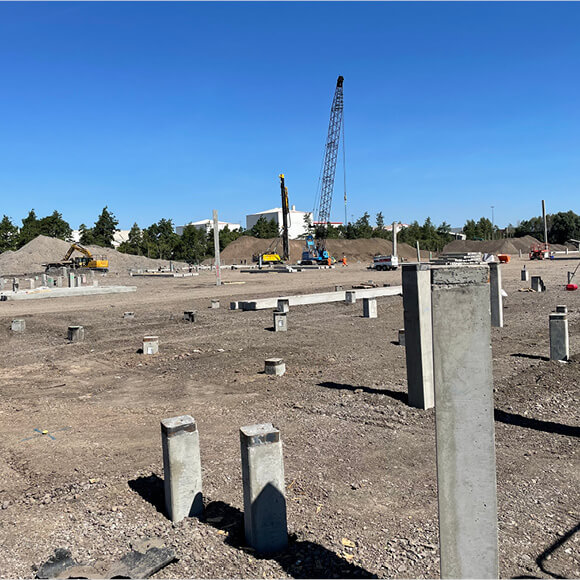
In the ETEX factory extension project, Tensar's mechanically stabilised platform incorporated with stabilisation geogrids was used on variable site conditions, saving 50% in embodied carbon
Geotechnical risk case study: North Heybridge Estate Road
At the North Heybride Estate Road project, a pavement design was required to form a capping layer over low-strength, variable soils in order to achieve a CD225 Foundation Class suitable for adoption by Essex County Council. The original design approach would have required significant volumes of imported granular fill, which increased both cost and material sourcing challenges due to the need to transport aggregates from outside the local area.
Tensar used a mechanically stabilised layer combined with InterAx geogrid, enabling the required pavement performance to be achieved while also managing construction trafficking over the weak subgrade. The reinforced capping layer improved load distribution and reduced deformation risk – allowing construction to proceed more efficiently over difficult ground conditions.
Overall, the project achieved a 54% reduction in construction costs, minimised construction time by 50%, and delivered a 57% reduction in environmental impact.
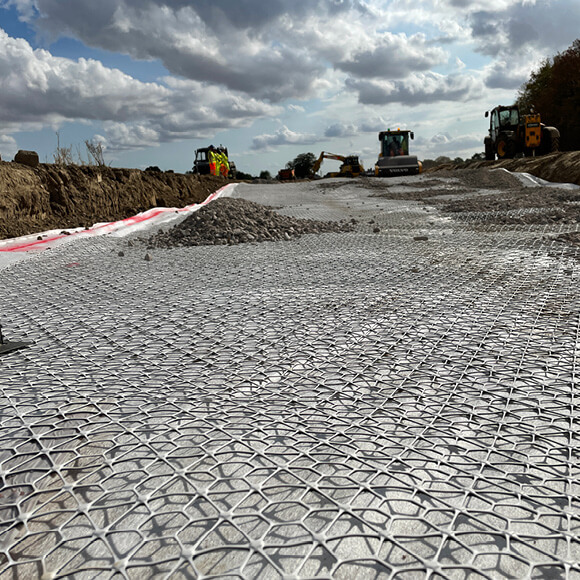
At North Heybridge Estate Road, Tensar used a mechanically stabilised layer with InterAx geogrid to improve weak subgrade performance, achieving cost savings, faster construction and reduced environmental impact.
How Tensar can help you manage geotechnical risk
This guide has introduced you to geotechnical risks, the importance of early geotechnical risk assessment and the common types of geotechnical hazards. We have also explored how these risks continue to affect construction projects, and the key methods used to assess, mitigate and manage them effectively.
Our free geotechnical Tensar+ software can support the design of ground improvement and stabilisation solutions, helping you optimise material use and develop efficient and buildable designs. By incorporating Tensar geogrids within mechanically stabilised platforms and foundation systems, you can improve load distribution, increase ground reliability and reduce uncertainty associated with variable soils.
If you have an upcoming project involving poor or variable ground conditions, get in touch today and submit your project details. We’ll provide a complimentary “Application Suggestion” outlining how our ground improvement solutions can help reduce geotechnical risk and deliver long-term value.