.png?width=400&height=400&ext=.png)
Field testing or laboratory testing?
Date: July 09, 2026
If you want the short answer to “which is better, field testing or laboratory testing?”, it’s this: both are best! In geotechnical engineering, the best answers usually come when the realism of field conditions is combined with the control and instrumentation of laboratory testing. Field testing gives you the ground as it really is, with all its natural variability, drainage behaviour and construction imperfections. Laboratory testing, on the other hand, allows you to control loading, moisture and boundary conditions, and to measure things in far more detail than is normally possible on site. Good geotechnical design has always relied on that combination.
That balance is exactly what is being explored in a full-scale railway test at the University of South Carolina. In the video, we are standing beside a large laboratory track section built to replicate a real ballasted railway: rails, sleepers, ballast, a sub-ballast layer and a sand subgrade. The loading is intended to simulate freight traffic, with a 35-tonne cyclic load at 3 Hz applied to the track. The purpose is not just to run another generic cyclic load test. It is to investigate how a mechanically stabilised sub-ballast layer, incorporating Tensar InterAx geogrid, performs when the track is subjected not only to repeated train loading, but also to heavy rainfall conditions.
This is where laboratory testing comes into its own. In the field, train loads vary, moisture conditions change from day to day, and it is difficult to isolate exactly why a track section is performing well or poorly. In the USC setup, the loading is known, repeatable and measurable. The test is instrumented with moisture sensors in the ballast, sub-ballast and sand subgrade, multi-depth deflectometers measuring movement through the layers, pressure sensors tracking how load is distributed downward, and accelerometers (“smart rocks”) to observe particle movement within the ballast. There is even painted ballast included so that ballast breakage can be identified when the section is dismantled. In other words, the laboratory makes it possible not just to see whether one section performs better than another, but to understand why.
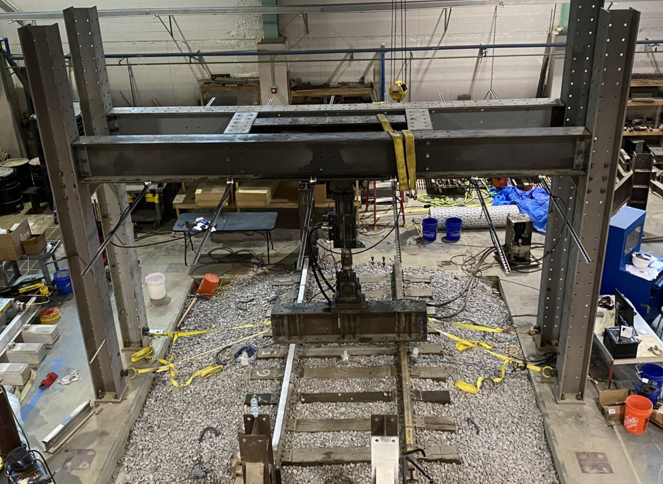
Above: An overhead view of the full-scale railway test rig at the University of South Carolina, recreating an authentic ballasted track structure inside the lab.
That level of control matters because the engineering question is not trivial. Ballast and sub-ballast are expected to spread traffic-induced stresses, maintain track geometry and protect the subgrade. Mechanically stabilising the aggregate with geogrid is intended to improve confinement, reduce lateral particle movement, improve load distribution and slow down permanent deformation. Tensar has discussed this performance mechanism before in relation to railways: when aggregate interlocks with a stiff geogrid, particle movement is restrained, bearing pressures on the subgrade are reduced, and track settlement can be slowed. The USC test is an opportunity to observe those mechanisms directly, at full scale, under controlled cyclic loading.
Of course, laboratory testing always attracts one fair criticism: the conditions are not fully real. That is the classic disadvantage. No matter how sophisticated the rig, it takes effort to reproduce the complexity of the field. Boundary effects, construction methods, drainage pathways, environmental exposure and long-term variability can all be difficult to capture in the lab. That is one reason geotechnical guidance and research consistently emphasise combining laboratory results with field observations and engineering judgement, rather than treating either in isolation.
What makes the USC programme particularly interesting is that it addresses this criticism directly. Toward the end of the video, the test demonstrates one of the most important realities of railway performance: it rains. Rainfall and moisture can transform the behaviour of granular railway layers. Research has shown that as ballast becomes wetter—especially when fines are present—drainage performance can drop, particles can rearrange more easily, settlement can accelerate, and track modulus can reduce significantly. Recent published work has shown that moisture and fouling together can markedly increase track settlement, while Federal Railroad Administration research has reported that moisture in fine-filled ballast can increase settlement dramatically compared with dry conditions. By physically introducing rainfall into the full-scale laboratory setup, the USC test closes part of the gap between neat laboratory idealisation and messy field reality.
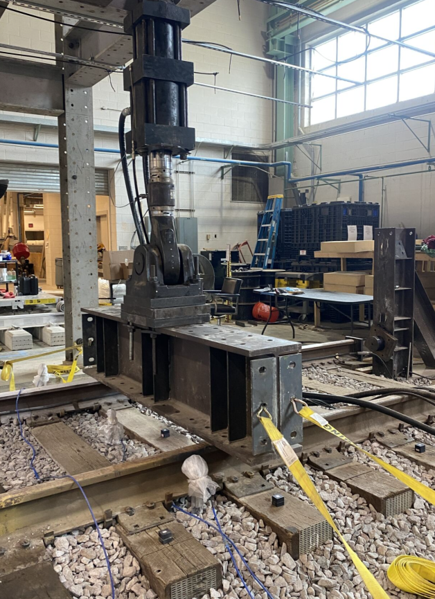
Above: The hydraulic actuator and loading assembly used to apply precise, repeatable 35-tonne cyclic loads to simulate heavy freight traffic.
That is, in many ways, the real lesson from this testing. It is not “field good, lab bad” or “lab good, field bad”. It is that each approach answers different questions. Field testing is excellent for realism and validation, but it is harder to control variables and to gather detailed internal measurements. Laboratory testing is excellent for control, repeatability and instrumentation, but it must work hard to recreate site conditions faithfully. The USC rail test is a good example of how to get the best from laboratory testing by making it more field-like: use a full-scale section, realistic train loading, extensive instrumentation and, crucially, introduce water so that the aggregate is tested under the kind of wet-weather condition that often drives deterioration in service.
There is also a practical design message here for railway engineers and asset owners. If a mechanically stabilised sub-ballast layer can maintain better load distribution, reduce ballast breakage and limit track deformation not only in dry conditions but also during heavy rainfall, then the benefit is not just academic. It points toward lower maintenance demand, better retention of track geometry and greater resilience in the face of wet-weather deterioration. For rail infrastructure increasingly exposed to intense rainfall events and rising maintenance pressures, that is exactly the kind of question worth testing properly. And sometimes, the best place to answer a real-world problem is in the laboratory—provided the laboratory is prepared to bring a bit of the real world inside.