Geogrids provide stabilisation or reinforcement to enhance the performance of soils, as well as separation between soil and aggregate layers. There are four main types of geogrid, each with different physical properties or characteristics. The most suitable type of geogrid in any given application will depend on both these physical properties along with the compatibility of the aggregate and soil.
We have a foundational guide on ‘What is geogrid?’ which is worth reading to get to grips with the fundamentals. In this guide, we’ll be looking at the physical properties of geogrids and how they impact suitability, before looking more closely at the key properties of Tensar geogrids in particular.
Use the links below to jump to the section you’re most interested in:
- Types of geogrid
- Property #1: Geogrid size and aperture
- Property #2: Geogrid strength
- Property #3: Geogrid junction efficiency
- Property #4: Radial stiffness
- Property #5: Elastic modulus
- Tensar geogrid types and their specifications
- What are the differences between the different types of geogrids?
- Key takeaways
Tensar geogrids can be used to solve civil and geotechnical engineering problems in or on the ground. They help design engineers to achieve substantial time- and cost-savings across a range of applications, from roads and railway trackbeds to working platforms and foundations. If this could be of use for your upcoming project, speak to our team today.
Types of Tensar geogrid
There are 4 geogrid types. The physical properties of geogrid vary by design type. For more information, please refer to our detailed guide about ‘What is geogrid?’.
Uniaxial geogrid: This geosynthetic product represents the cutting edge in soil reinforcement technology.
Biaxial geogrid: This is the original geogrid for construction over weak soils, invented by Tensar in the 80s.
TriAx®: Tensar's TriAx® technology represents an advancement over traditional biaxial geogrids. It incorporates a hexagonal structure with triangular apertures. The design's emphasis is not solely on tensile strength, but rather on achieving superior mechanical stabilisation.
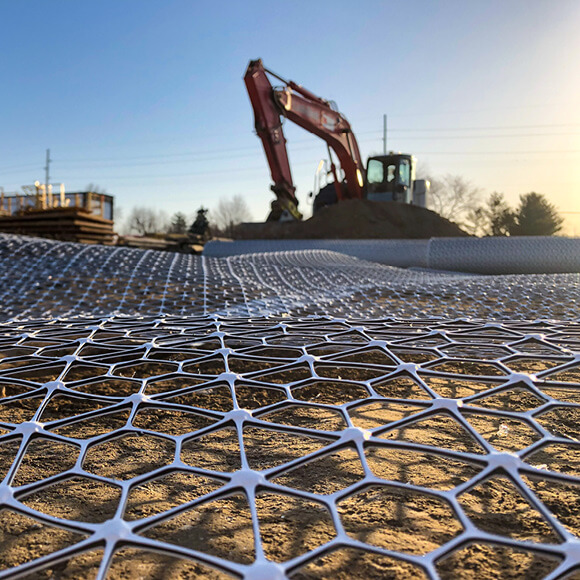
Property #1: Geogrid size and aperture size
It is important to note that physical properties of Tensar stabilisation geogrids – TriAx, H-Series and InterAx – are not used to predict performance when included ina granular layer. Some characteristics have been identified but they should not be assessed individually, but in combination.
In order to allow interlock and confinement of aggregate to take place effectively, there must be compatibility between the aggregate particle size and the geogrid aperture size. For TriAx geogrids, there are different-sized geogrids for a range of fill particle sizes:
- 66mm
- 80mm
- 120mm
Tensar InterAx, there are different aperture sizes within the single geogrid structure. This provides compatibility with a typical aggregate that comprises a range of particle size.
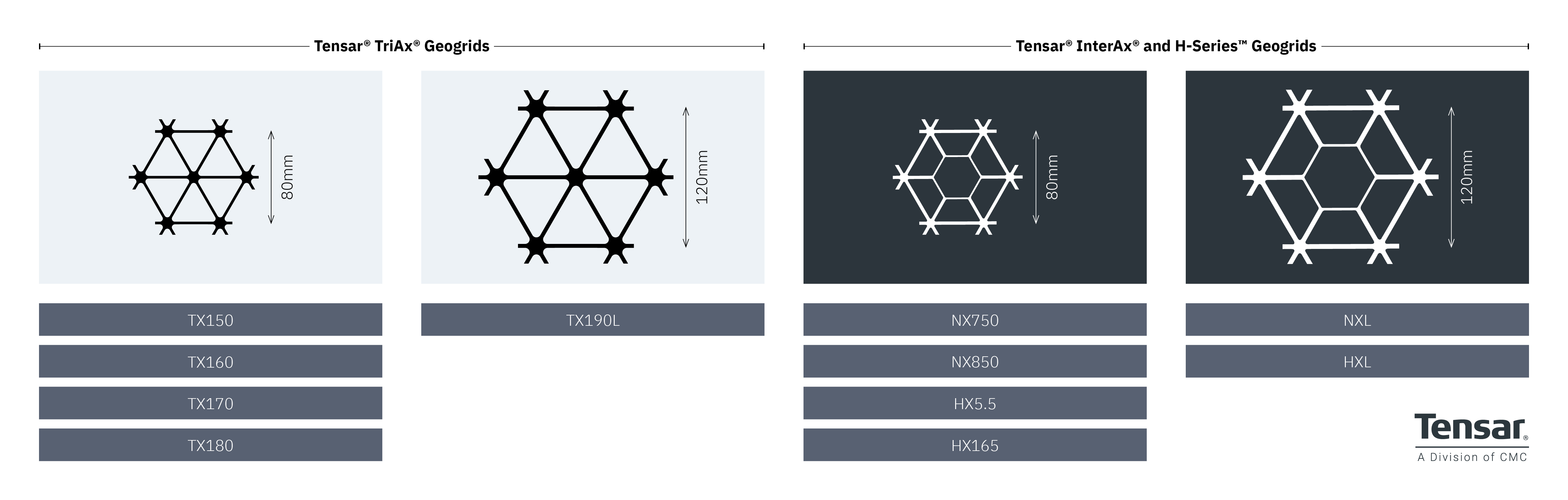
Tensar geogrid sizes and apertures
Do all geogrids work the same?
No, they don’t. Geogrid performance is not defined by individual physical properties alone. Instead, the effectiveness of a geogrid when included in a granular layer, often referred to as a mechanically stabilised layer (MSL), depends on how the geogrid interacts as a complete system within the granular road, working platform, or rail trackbed.
Rather than focusing on isolated dimensions, it is critical to understand the proven performance of the geogrid in its intended environment. Tensar carry out full scale validation testing to confirm expected performance when included in a granular material. Tensar’s advanced geogrids are engineered specifically to optimise this interaction, ensuring high-performance load distribution and long-term durability in all trafficked areas.
Property #2: Geogrid strength
Geogrid strength can refer to a number of different properties, including:
- Ultimate tensile strength
- Wide-width tensile strength
- Single rib tensile strength
- Long-term design strength
While the design strength of geogrids for the function of reinforcement is a critical property, for the function of stabilisation, the interaction between geogrid and granular fill is important to understand. Some parameters are needed to characterise the geogrid with descriptions included below, but no physical properties of a Tensar stabilisation geogrid are used in road or platform calculations so performance characteristics are based on extensive full-scale trials to validate expected performance.
Do all geogrids work the same?
No, they don’t. Geogrid performance is not defined by individual physical properties alone. Instead, the effectiveness of a geogrid when included in a granular layer, often referred to as a mechanically stabilised layer (MSL), depends on how the geogrid interacts as a complete system within the granular road, working platform, or rail trackbed.
Rather than focusing on isolated dimensions, it is critical to understand the proven performance of the geogrid in its intended environment. Tensar carry out full scale validation testing to confirm expected performance when included in a granular material. Tensar’s advanced geogrids are engineered specifically to optimise this interaction, ensuring high-performance load distribution and long-term durability in all trafficked areas.
Do all geogrid types of the same strength work the same?
No. For road, platform, rail and other trafficked application, geogrid strength does not correlate with in-ground performance. The ability of the geogrid to interlock and confine the aggregate subjected to traffic loading is fundamental to delivering enhanced performance of the mechanically stabilised layer (MSL). This enhanced performance can only be measured through full-scale in-ground trafficking testing. Geogrid characteristics, including rib shape, aperture shape, polymer type, material structure configuration, rib thickness, junction efficiency, and geogrid-aggregate compatibility, among others, contribute to the amount of interlock and confinement achieved, thereby enhancing the performance of the MSL.
The answer is similar for wall and slope applications. Long term design properties of different types of geogrid can vary dependent on project conditions such as soil types, loading and required facing.
Ultimate tensile strength of geogrids
Ultimate tensile strength (UTS) is the maximum amount of load a geogrid can handle before performance is compromised.
This is established through tensile testing, where the geogrid is stretched until it breaks. Testing the UTS of a geogrid takes place over a very short time period – minutes or seconds - and therefore is a poor indicator of expected performance when design life is needed for months or years.
Many geogrid specifications focus on tensile strength, equating high UTS with better performance. In reality, however, UTS is irrelevant, particularly when a geogrid is used in the design of roads or other trafficked areas.
In these cases, the ultimate tensile strength of a geogrid alone is actually a poor indicator of performance. In order to develop its UTS, the geogrid must strain to around 10% which would typically result in what is known as the ‘tensioned membrane’ effect - similar to what happens when a person sits on a hammock. This can result in excessive deformation in the granular layer with failure or the need for regular maintenance.
Consequently, the pavement will suffer deformation at the level where the reinforcement geogrid is placed. Deformation will also likely appear at the road surface level in the form of rutting, cracks and potholes, reducing its operational life.
Learn more about Why tensile strength is not a good measure of stabilising geogrid performance.
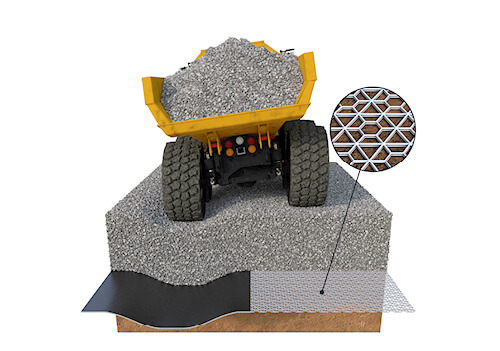.jpg) Performance of a Tensar mechanically stabilised layer (right) versus Tensioned Membrane (Left)
Performance of a Tensar mechanically stabilised layer (right) versus Tensioned Membrane (Left)
Long-term design strength
Long-term design strength (LTDS) is a relevant property of geogrids in reinforced soil applications—including retaining walls and slope reinforcement—where layers of geosynthetic materials (such as geogrids) are placed within the fill used to form the finished structure.
Unlike roads, which bear a constantly changing load, reinforced soil carries a permanent load throughout its operational life, which could be up to 120 years. Consequently, the design of the structure and load-bearing components (including the geogrids) should reflect this.
Factors used to calculate LTDS
Creep strength
Polymers are viscoelastic, meaning their strength and stiffness are affected by temperature and how frequently or long they bear a load. Under a constant load, polymer geogrids will stretch very gradually as their physical properties change.
Creep strength can be assessed by subjecting geogrids to long-term loading. This involves suspending different-sized weights from the geogrid in temperature-controlled conditions and measuring and recording the strain for a standard duration of 10,000 hours, just over a year.
Partial reduction factors
Partial reduction factors—such as environmental effects and the effect of damage caused during installation—should be applied before using creep strength in LTDS calculations.
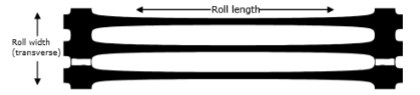
Uniaxial geogrids are also available in different grades, but their geometry is similar across the range.
Property #3: Geogrid junction efficiency
A characteristic of stabilisation geogrids known as junction efficiency is the measure of the strength of the node compared to the strength of the rib, expressed as a percentage and indicates the ability of the geogrid to transfer loads from one rib to other ribs in different directions:
Junction efficiency—and not junction strength—is a parameter the European Assessment Document (EAD) characterises and associates with stabilisation geogrid performance.
The EAD sets out parameters the European Organisation for Technical Assessment (EOTA) confirms are specific to the distinct function of stabilisation. No such link has been made between any junction parameters and reinforcement geogrids.
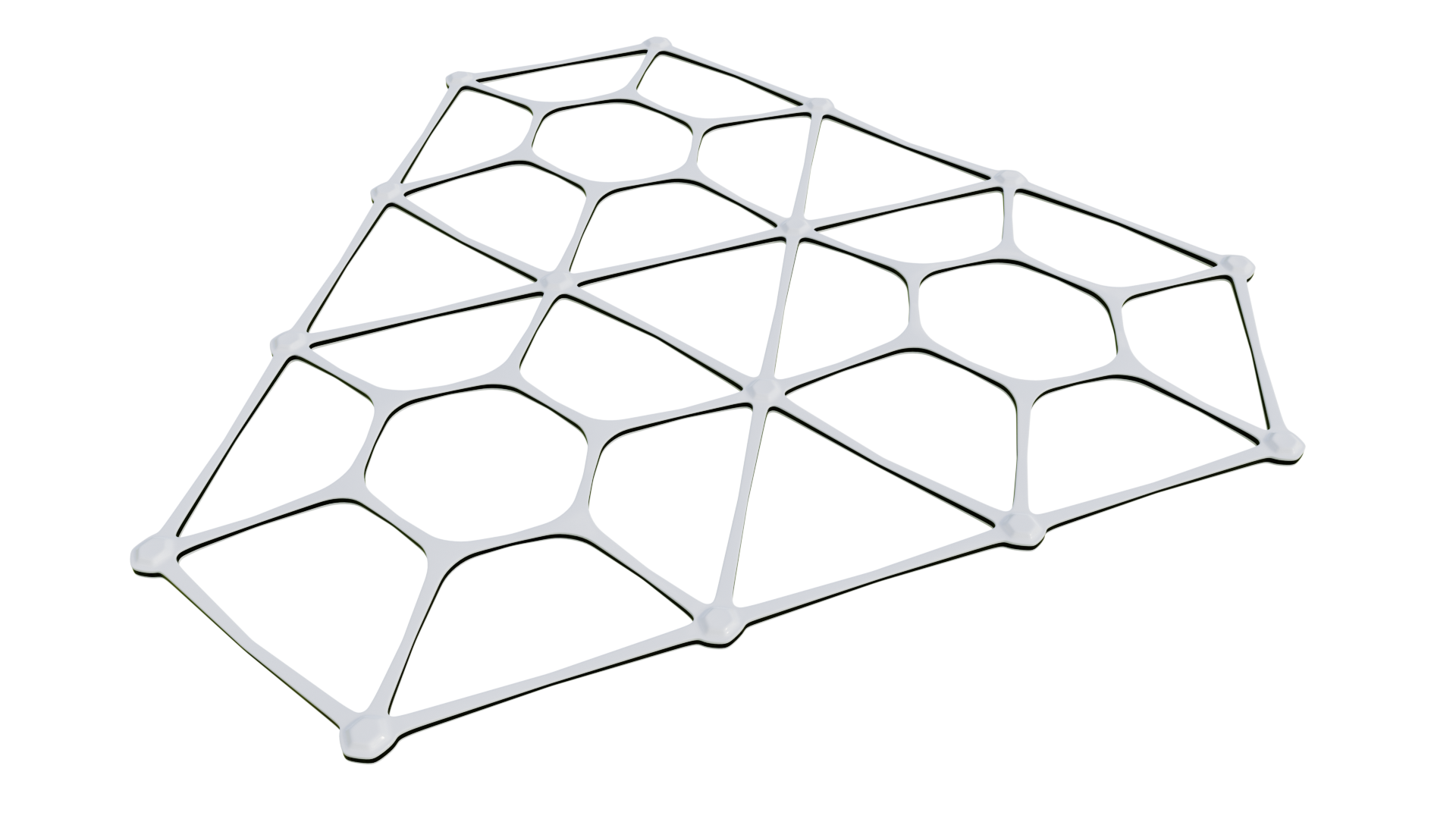
Junction efficiency vs. tensile strength
Where stabilisation geogrids are used to take advantage of the ‘confinement effect’, junction efficiency has been identified as characteristic with more importance than product tensile strength to predict the performance of an MSL.
The confinement effect: the effect of the mechanism of interlock by which the structure of the geogrid restrains the aggregate/granular fill particles.
Granular particles bear against the ribs in the geogrid structure, which are held in place by the junctions. As a result, the efficiency of the junctions compared to the rib is one characteristic that characterises performance of a stabilisation geogrid.
Property #4: Radial stiffness
Radial stiffness, is in-plane stiffness measured in a four directions around the geogrid structure. The mean radial stiffness is the average stiffness measured in these multiple directions, while the radial stiffness ratio is an indication of the uniformity (isotropy) of radial stiffness. These two characteristics provide indicators of the ability of a stabilisation geogrid to evenly distribute a load through 360 degrees, without deforming elastically.
Mean radial stiffness and radial stiffness ratio are characteristics of stabilisation geogrids associated with the stabilisation function, with the geogrid acting as a component of a mechanically stabilised layer in road applications. The overlapping hexagonal structure of Tensar’s TriAx and Tensar InterAx geogrids provides a more uniform response to the load traffic imposed on the road than geogrids with square or rectangular apertures.

Property #5: Elastic modulus
Elastic modulus is another physical property of geogrids related to stiffness but not related to performance in ‘normal’ applications.
Finite element analysis (FEA) sometimes requires a geogrid’s elastic modulus. However, Tensar’s own research has confirmed that the effect of a geogrid should not be modelled on individual product parameters. We have developed an FEA module—for more information, contact the Tensar Technology team.
Tensar geogrid types and their specifications
Tensar supplies a number of geogrid solutions to solve geotechnical engineering problems across several applications. The physical properties of each of these have been outlined below:
Tensar InterAx® geogrids
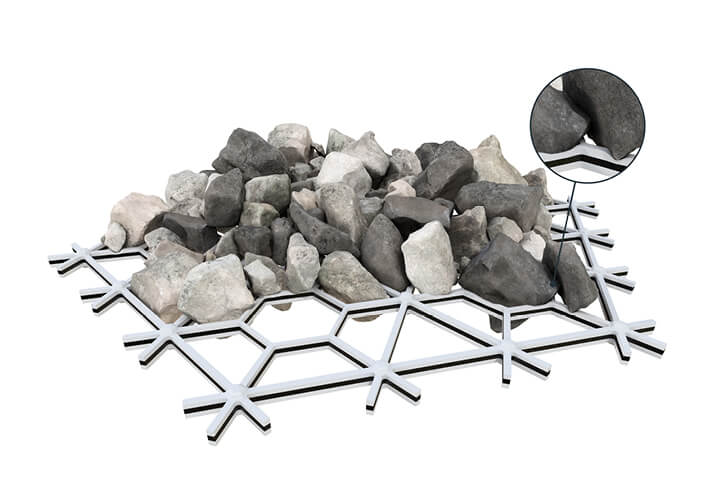
- Manufacturing process - coextrusion
- Three different aperture sizes - Triangular, hexagonal & trapezoidal
- Ductile outer layer – improves interlock.
- Complex geometry
- Higher rib aspect ratio
- Elevated inner hexagon
Tensar’s InterAx® geogrids are classified as stabilisation geogrids. The performance, i.e., the effectiveness in stabilising a granular material, cannot be characterised by any single physical property of the geogrid. It is defined only by its stabilisation effect. This is derived from multiple tests conducted on Tensar InterAx geogrid in combination with various aggregate types.
For product identification purposes (not performance-related characteristics), the following physical characteristics may be used:
- Aperture shapes
- Structure
- Rib shape
- Continuous parallel rib pitch
- Rib aspect ratio
- Node thickness
- Colour identification
Tensar® InterAx® geogrids provide the best performance and best value of any other Tenar geogrid. This geogrid material specification includes InterAx® NX750, NX850, NX950, NXL, NX-G, NX-GD and NX-GN.
Download our documents if you are interested in Tensar® InterAx® geogrid products, installation guides and characteristics.
TriAx geogrids
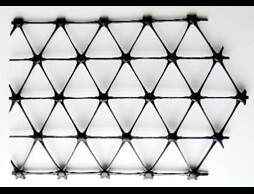
- Radial stiffness at 0.5%
- Radial stiffness ratio
- Junction efficiency
- Hexagonal pitch
Tensar’s TriAx geogrids are classified as stabilisation geogrids. The properties noted are associated with this distinct function.
Biaxial geogrids
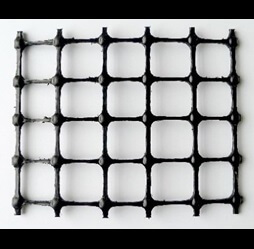
- Ultimate geogrid tensile strength
- Strength at 2% strain
- Strength at 5% strain
- Peak strain
Biaxial geogrids such as Tensar’s SS geogrid are classified as reinforcement products. Geogrid tensile strength and associated strain are properties relevant to this distinct function.
To learn more about Tensar® Biaxial geogrid products, including their characteristics and installation guides, you can download our documents:
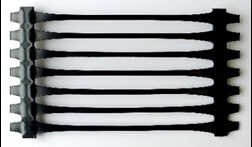
Tensar uniaxial geogrids
- Creep Strength
- Long-term design strength*
- Ultimate tensile strength**
Uniaxial geogrids such as Tensar’s RE geogrid are classified as reinforcement products, specifically for wall and slope applications.
Long-term design strength is based on project-specific conditions. Partial reduction factors should be applied based on variables such as in-soil temperature and installation damage.
**Ultimate tensile strength is not a parameter employed in design calculations but can be used to identify which product is required.
Access all the information you need on Tensar® Uniaxial geogrids, including product characteristics and specifications guides, by downloading our documents:
What are the differences between the different types of geogrids?
Characteristic | InterAx (NX) | H-series HX | TriAx (TX) | BX |
|---|---|---|---|---|
Development | Coextruded with optimised geometry to provide the best performing geogrid from Tensar. | Optimised geometry to improve on TX performance. | TriAx geogrids were introduced in 2007, which marked an advancement in geosynthetic technology | Original geogrid based on 40-year-old technology. |
Aperture Geometry | Triangular, Hexagonal, Trapezoidal | Hexagonal, Trapezoidal & Triangular | Triangular | Square |
Material Structure | Coextruded - Three Layers | Integrally Formed | Monolithic - Single Layer | Monolithic - Single Layer |
Performance | Best load distribution and interlocking capabilities with various types of fill materials | Improvement available over TX and BX geogrids | Adequate load distribution and interlocking capabilities | Limited load distribution |
Performance Differential | 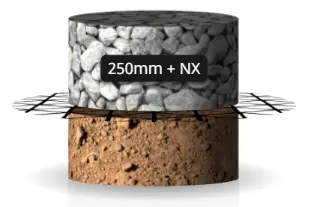 | 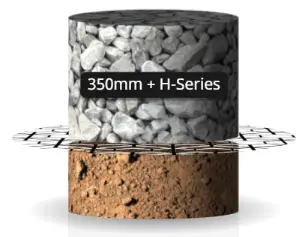 | 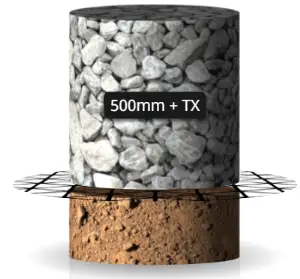 | 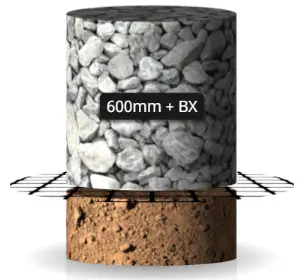 |
Properties of geogrids: key takeaways
This guide has explained the various physical properties of geogrids and their importance for certain types of applications. The key points are summarised below:
- Physical properties associated with geogrids depend on the intended application.
- Always consider a geogrid’s performance in context as part of an overall system—the benefit is in how the geogrid interacts with the layers around it, not by virtue of its standalone properties.
- Most physical properties of geogrids used in the industry to gauge performance are inappropriate.
- Ultimate geogrid tensile strength is not the most important factor in how well it will perform, particularly in road applications

Design with confidence, from anywhere.
- Design & evaluate pavement and gravel sections
- Design & evaluate working platforms
- Easily compare alternative materials
- Determine initial and lifecycle cost savings, time savings, and sustainability metrics
- Create high-level summaries of the design alternatives for project stakeholders
- Share features that aid collaboration

Discover how Tensar geogrids could save time and money on your next project
For further information about Tensar geogrids and their physical properties, contact us. If you’ve enjoyed reading this guide and would like to see some other related resources, take a look at: